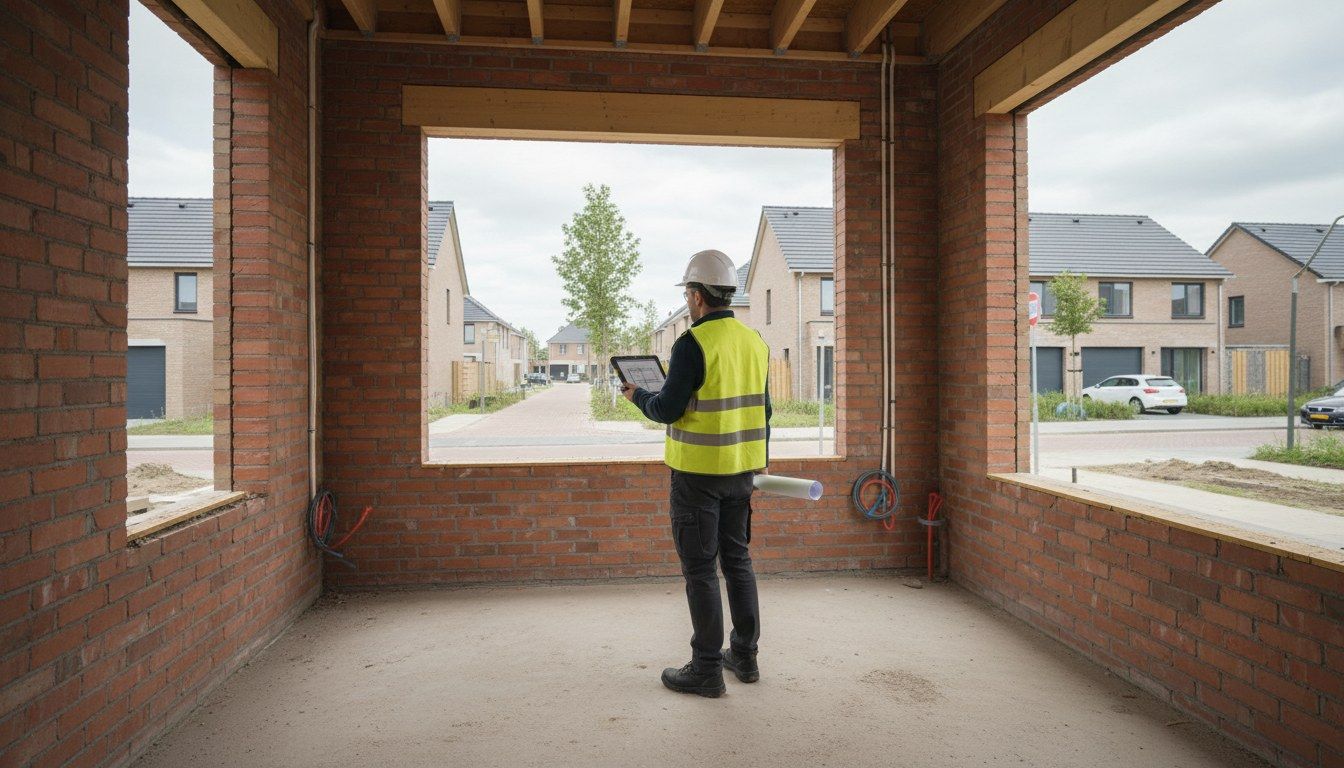
Since late August 2026, three quality assurers have been listed as suspended in the register of the Dutch Building Quality Assurance Admission Body (TloKB). Without valid quality assurance, construction may not continue, and in early September the Association of Dutch Municipalities estimated that possibly 1,300 projects were affected. The trade association of quality assurers asked its members to help clients and contractors and to take over projects.
Whoever takes over such a project will eventually sign a declaration on work that another firm has assured. That is not a formality: the declaration at completion is a personal judgement that the building, on justified confidence, complies with the Dutch Building Decree (Besluit bouwwerken leefomgeving, Bbl). A file that is taken over must be able to carry that judgement. Below are the five questions the file has to answer.
1. Which assurance plan and which risk assessment is the assurance based on?
The assurance plan is the backbone of quality assurance. It must be based on an assessment of the technical construction risks and must state when it is updated (article 3.80 of the Environmental Quality Decree, Bkl). On takeover you want to see not only the plan but also the risk assessment underneath it, and the moments at which both were revised: a changed design, a different contractor, a deviation on site. A plan without an update trail does not tell you what has changed since the start.
2. Which deviations were found, who was informed, and what was done about them?
The quality assurer must promptly inform the client and the parties involved of any deviations found, and must also inform the competent authority if the deviation stands in the way of issuing the declaration (article 3.86(1) Bkl). In a file you take over, you are therefore looking for three things per deviation: the finding, the notification and the follow-up. If one of the three is missing, you are inheriting an open item whose history you do not know.
3. Which documents are missing?
Working drawings, structural calculations, the fire safety report, quality declarations and product certificates: the presence of these documents says nothing about their content yet, but their absence does say something about the file. Start the takeover with a completeness list and keep it separate from the technical review. "Present" and "reviewed" are two different ticks, and it is wise to make explicit in your own report which of the two you have placed.
4. Which version of the Bbl applies?
The construction notification must be filed at least four weeks before construction starts (article 2.18 Bbl), and the law in force at that moment remains the yardstick. If construction does not start within a year of the notification, a new notification is required and the law current at that time applies (article 2.18(2) Bbl). The Bbl changes several times a year. On takeover, the date of the construction notification is therefore one of the first things to record, because it determines which text you test against.
5. Can the evidence be traced per inspection, with date and log?
Photos, measurement reports and inspection records should be traceable to an inspection moment, a location in the building and a requirement in the assurance plan. Evidence that only exists as loose files in a folder is hard to use on takeover: you do not know what was reviewed and what was merely collected. So ask for the evidence as it is recorded in the assurance instrument, with date and log, rather than an export from a proprietary system.
Why this matters now
The Dutch quality assurance system tests for independence and for demonstrability, not for speed or price. A quality assurer who takes over a project also takes over the burden of showing that the assurance so far was in order. These five questions are not extra bureaucracy; they are the shortest route to a declaration you can sign with confidence.
How VERA helps
VERA, Prudai's AI colleague for construction regulation, knows the role of the quality assurer. You give VERA a file; VERA names the legal basis in the Bbl, with article number, for each finding, flags which documents are missing and states what it has not recalculated. VERA works from the reference date of the construction notification and retrieves the article texts live from wetten.overheid.nl. The judgement and the declaration remain with the quality assurer; VERA is not an admitted instrument and does not replace the instrument you work with. Documents stay within your own organisation's environment, on Prudai servers in European data centres. VERA can be tried free for fourteen days, without a credit card.
Sources
- Register of quality assurers, TloKB (consulted 22 September 2026)
- Quality assurer suspended: what now? TloKB, 2 September 2026
- Briefing on the current Wkb situation: suspension of quality assurers, VNG, 9 September 2026
- Around 1,300 projects halted after quality assurance problems, BouwTotaal, September 2026
- Environmental Quality Decree (Bkl), articles 3.80 and 3.86, wetten.overheid.nl
- Building Decree (Bbl), article 2.18, wetten.overheid.nl
Want to know how VERA maps a file you have taken over? See VERA for quality assurers or contact us.