Since 1 January 2024, Dutch building law has been part of the Omgevingswet, the Environment and Planning Act. The technical requirements for buildings are in the Besluit bouwwerken leefomgeving (Bbl), which replaced the Bouwbesluit 2012. For simple new builds in consequence class 1, such as most single-family homes, the Wet kwaliteitsborging voor het bouwen (Wkb, the Quality Assurance for Construction Act) also applies: you file a construction notice in advance, an independent quality assurer checks the work while it is being built, and you finish with a completion notice and a file.
Key points
- The Omgevingswet has applied since 1 January 2024. Building is split into a technical part and a zoning part.
- The Bbl contains the technical building rules and replaced the Bouwbesluit 2012.
- In consequence class 1, a construction notice at least four weeks before the start replaces the technical permit. A quality assurer working with an approved instrument checks the work.
- Before the building is used, you file a completion notice with the file for the competent authority. At handover, the contractor also gives the client a handover file.
- From late August 2026, quality assurers were suspended and projects came to a halt. Renovation and consequence classes 2 and 3 are not yet covered by the Wkb.
What does the Omgevingswet change for construction?
Since 1 January 2024, the Omgevingswet has brought the old Dutch laws on the physical living environment together into one system. For construction that means one environment plan (omgevingsplan) per municipality, one digital desk and a split between technical and zoning rules.
Permit applications and notices go through the Omgevingsloket, the national online desk. Two decrees under the act matter most for construction: the Besluit bouwwerken leefomgeving (Bbl) with the technical rules, and the Besluit kwaliteit leefomgeving (Bkl), which sets, among other things, the requirements for quality assurance.
Local rules are in the omgevingsplan: one per municipality (art. 2.4 Omgevingswet), with rules on matters such as building height, plot coverage, appearance and permitted uses. The old zoning plans (bestemmingsplannen) count for now as a "temporary part" of that plan. The legal provisions for that temporary part lapse on 1 January 2032.
The split: technical and zoning
The Omgevingswet splits building into two activities. The government's information point IPLO calls this "de knip", the cut.
- The technical building activity. Does the building meet the technical rules of the Bbl, such as structural safety, fire safety and energy performance?
- The zoning plan activity for buildings. Does the building fit the local rules of the omgevingsplan?
A building plan can therefore require only a notice on the technical side and still need a permit on the zoning side. Under the regular procedure, the municipality decides on a permit application within eight weeks, which it may extend once by up to six weeks (art. 16.64 Omgevingswet). The extended procedure (art. 16.65 Omgevingswet) has longer time limits.
What is the Bbl, and how does it differ from the Bouwbesluit?
The Bbl contains the technical rules for buildings. It replaced the Bouwbesluit 2012, which lapsed on 1 January 2024. If you still search for "Bouwbesluit", the Bbl is what you need.
Its structure will feel familiar:
- chapter 3: existing buildings;
- chapter 4: new buildings;
- chapter 5: renovation, relocation and change of use;
- chapter 6: use of buildings;
- chapter 7: construction and demolition work.
Chapter 2 contains the general rules, including the rules on quality assurance (articles 2.17 to 2.21) and what does or does not need a permit.
The Bbl changes often: the version in force is dated 24 September 2026, and the next amendment is scheduled for 1 January 2027. For an example of such a change, see Bbl 2026 and EV charging points in parking garages.
So record for each project which version you test against. In consequence class 1, the construction notice is the legal reference point for the rules, according to the Ministry of the Interior (BZK) and the association of Dutch municipalities (VNG). If the Bbl changes after the notice, the rules in force at the time of the notice continue to apply for one year (art. 8.3(3) Bbl). If construction does not start within a year of the notice, you file again (art. 2.18(2) Bbl) and the law of that moment applies.
What is the Wkb, and which buildings fall under consequence class 1?
The Wkb (Bulletin of Acts and Decrees 2019, 382) moves the technical building check from the municipality to an independent quality assurer. Since 1 January 2024 this applies to new builds in consequence class 1, the lowest risk class.
The Wkb does two things. A paper check in advance makes way for a check in practice, on site and during construction. And after handover, the contractor remains liable for defects that were not discovered at handover. That second part is in the Dutch Civil Code and applies to every construction contract for a building concluded from 1 January 2024.
Article 2.17 of the Bbl defines consequence class 1. It covers new builds of:
- ground-level homes that are not part of an apartment building, such as terraced and detached houses (homes for care and room rental are excluded);
- floating homes;
- ground-level lodging that is not part of a lodging building;
- buildings with an industrial function of no more than two storeys, including an annex with an industrial function that belongs to another use;
- bridges for pedestrians and cyclists with a span of up to 20 metres, not over a national or provincial road;
- other structures that are not buildings, up to 20 metres high, with exceptions such as flood defences.
A project still falls outside class 1 if it concerns a listed monument, or if a use notice is required, for example because many people are present at the same time. The same applies if you use an equivalent measure for structural or fire safety, if you use NEN 6060 or NEN 6079 for the size of a fire compartment, or if a permit-bound environmentally harmful activity is involved. For now, renovation does not fall under class 1 (art. 2.17(4) Bbl).
In practice, you no longer apply for an environmental permit for the technical part (art. 2.27(1)(a) Bbl). You choose a quality assurer, file a construction notice at least four weeks before the start (art. 2.18 Bbl) and file a completion notice at least two weeks before the building is used (art. 2.21 Bbl). The zoning part may still need a permit; that depends on the omgevingsplan.
What does a quality assurer do, and what not?
A quality assurer (kwaliteitsborger) is an independent private party. Using an approved instrument, the assurer assesses whether the building meets the Bbl rules and records that in a declaration at the end.
Formally, the quality assurer applies an approved instrument with the permission of an instrument provider (art. 7aa Woningwet). An instrument is an assessment method: how the assurer checks and what they record. The admission body TloKB (Toelatingsorganisatie Kwaliteitsborging Bouw) approves instruments and keeps a public register. The instrument provider supervises the assurers themselves and can issue a warning, suspend them or withdraw permission.
What the quality assurer does is set out in the Bkl:
- Assurance plan. Before the start, the assurer adopts an assurance plan (borgingsplan) based on an assessment of the technical risks (art. 3.80 Bkl). It sets out which measures limit those risks and when the assurer will check.
- Independence. The assurer has no organisational, financial or legal involvement in the project other than through the assignment (art. 3.82 Bkl).
- Reporting deviations. If the assurer finds a deviation from the Bbl, they report it without delay to their client and the other parties. If the deviation stands in the way of the declaration, they also inform the municipality (art. 3.86(1) Bkl).
- Declaration. Afterwards, the assurer gives their client a declaration that, in their judgement, there is justified confidence that the building meets the rules (art. 3.86(2) Bkl). The other parties receive a copy.
What the assurer does not do is take over responsibility. That stays with the contractor and the client, as BZK and the VNG stress. A declaration with a reservation does not exist: the assurer either issues the declaration or tells the municipality where the building falls short.
Which files do you deliver: the authority file, the consumer file or the handover file?
There are two files with three names. The file for the competent authority goes to the municipality with the completion notice. The consumer file, often called the handover file in practice, goes to the client at handover.
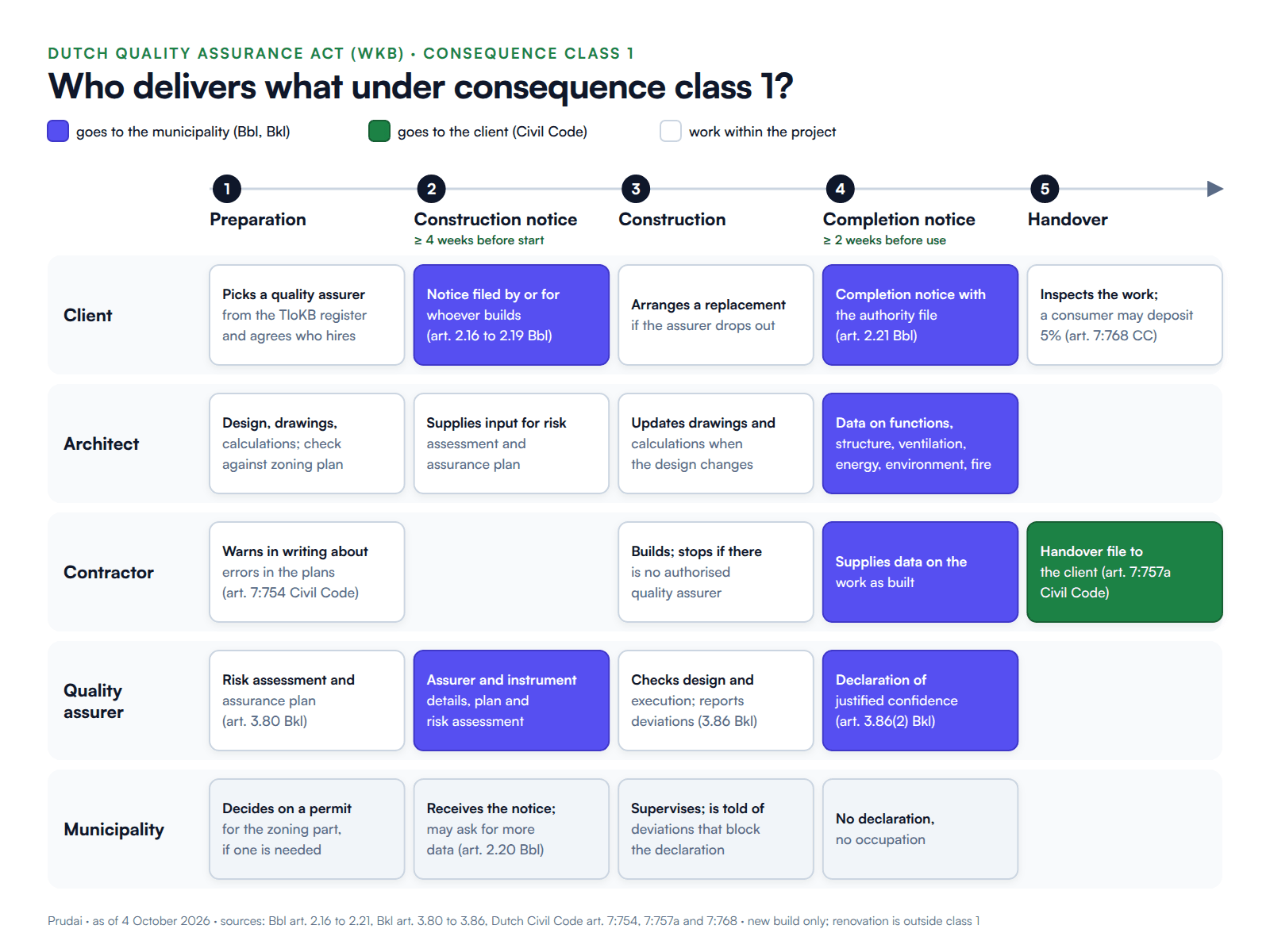
Diagram: who delivers what under consequence class 1, per party and per phase, from preparation to handover
Who delivers what under consequence class 1. Sources: Bbl, Bkl and Dutch Civil Code, as of 4 October 2026.
| File for the competent authority | Consumer file (handover file) | |
|---|---|---|
| Legal basis | Art. 2.21 Bbl (public law) | Art. 7:757a Civil Code (private law) |
| Applies to | Buildings in consequence class 1 | Every construction contract for a building concluded from 1 January 2024, also outside class 1 and also for business clients, unless the parties agree otherwise |
| Who delivers it | Whoever files the completion notice, with documents from designers, consultants, contractor and quality assurer | The contractor |
| To whom | The municipality (competent authority) | The client |
| When | With the completion notice, at least two weeks before use | When the contractor reports the work as ready for handover |
| Contents | The quality assurer's declaration; uses, rooms and floor areas; structure; ventilation; energy performance; environmental performance; fire safety; equivalent measures | Drawings and calculations for the building and installations; materials and installations used; uses; information for use and maintenance |
The term "handover file" (opleverdossier) does not appear in the law: article 7:757a of the Civil Code simply refers to "a file". IPLO calls it the consumer file or handover file; they are the same document.
The two files do overlap. Drawings, calculations and uses appear in both. Keeping one source and building both files from it prevents the municipality and the client from receiving different versions.
What changes for architects, contractors and clients?
The Wkb moves work to an earlier stage and records more. Each party's role shifts a little as a result.
Architects and designers
- No advance check by the municipality. The quality assurer assesses the design for the assurance plan and during construction. Supply drawings and calculations early and in full.
- Design choices determine the route. An equivalent measure for fire or structure, or a fire compartment based on NEN 6060 or NEN 6079, takes the project out of class 1. The technical part then normally needs a permit again.
- Your documents get a closer read. The contractor must report errors in plans, drawings and calculations supplied by the client in writing and unambiguously (art. 7:754(2) Civil Code).
- Local conditions. Ground or surroundings belong in the risk assessment filed with the construction notice (art. 2.19(2) Bbl). The design team is often the first to know them.
Contractors
- Liability. After handover you remain liable for defects not discovered at that time, unless they cannot be attributed to you (art. 7:758(4) Civil Code). Towards a consumer you cannot deviate from this; towards a business client only explicitly in the contract.
- Duty to warn. Warn in writing and unambiguously, and point out the possible consequences in good time (art. 7:754(2) Civil Code).
- Handover file. Hand over the file when you report the work as ready for handover (art. 7:757a Civil Code).
- A home for a consumer. Inform the client in writing in advance whether and how the work and your liability for defects are covered by insurance or other financial security (art. 7:765a Civil Code). The consumer may deposit up to 5% of the contract price with a civil-law notary (art. 7:768 Civil Code).
- No quality assurer, no construction. If the assurer drops out, work stops, even without a letter from the municipality (TloKB).
Clients
- Choose the quality assurer. Find one in the TloKB register and agree who hires them. That party is the assurer's client and receives the declaration (art. 3.86 Bkl).
- No declaration, no occupation. Without a declaration the completion notice is incomplete, and without a completion notice the building may not be used (art. 2.21 Bbl).
- Agree what happens if the assurer drops out. Record who finds a replacement and who bears the cost of any standstill.
- Self-builders too. If you build yourself, without a contractor, you still need a quality assurer in class 1 (IPLO).
What do the 2026 suspensions of quality assurers mean?
From late August 2026, instrument providers suspended several quality assurers. Projects of a suspended assurer could not continue until a new assurer was appointed or the suspension was lifted.
On 2 September 2026, the TloKB reported that two instrument providers had suspended three quality assurers. Another suspension followed on 7 September (TloKB register). In mid-September, three quality assurers were suspended according to BZK and the VNG.
During a suspension, an assurer may not carry out quality assurance or issue a declaration (TloKB). Without quality assurance, construction may not continue. That follows directly from article 7ab(3) of the Woningwet (Housing Act), without a separate decision by the municipality (BZK and VNG, 14 September 2026).
Of the affected projects that were not yet finished, around 85% were housing, with about 1,225 homes (BZK and VNG). The suspensions initially applied for three months.
On 23 September 2026, the District Court of Midden-Nederland limited one of the suspensions in interim relief proceedings (ECLI:NL:RBMNE:2026:6540). For ongoing projects with a construction notice filed before 25 August 2026, the suspension had to be lifted; for later notices it stayed in place (TloKB, 23 September 2026). This is a provisional ruling; the main case is still to come. Always check the TloKB register for the current position.
What can you learn from this, even if your project was not affected?
- Takeover is possible. Another quality assurer may take over the project, even with a different instrument. No new construction notice is needed, but the assurance plan must be updated.
- The new assurer must be convinced in their own right. Their declaration also covers work assessed by the previous assurer. If checks were not recorded, additional investigation may be needed, for example of a foundation.
- Traceable evidence pays off. Evidence that links to an inspection moment, a location and a requirement in the assurance plan makes a takeover much easier.
For how to work through such a file, read Taking over a project from a suspended quality assurer: five questions for the file.
Will the Wkb also cover renovation and consequence classes 2 and 3?
Not yet. Its introduction for renovation has been postponed without a new date, and consequence classes 2 and 3 will come at the earliest after the Wkb evaluation, which is planned for 2027.
The position on 4 October 2026:
- Renovation. The introduction for renovation is postponed for now and has no start date (IPLO). In December 2024 the minister decided "not now", mainly because of the relatively high costs for smaller projects. Municipalities can run pilot projects for renovation.
- Consequence classes 2 and 3. These cover, for example, libraries and school buildings (class 2) and football stadiums and hospitals (class 3). Whether and when they follow depends on the evaluation (IPLO). The monitoring report of 29 May 2026 puts any extension at no earlier than five years after class 1 started.
- Bbl. According to BZK and the VNG, a new article 2.21a is planned for 1 January 2027: a power to set customised rules on occupation, in the quality assurance section. It has not yet been published (as of 4 October 2026).
Checklist: what to arrange in each phase
1. Design and preparation
- Determine whether the project falls under consequence class 1 (art. 2.17 Bbl).
- Check the design against the omgevingsplan; apply for a zoning permit where needed.
- Choose a quality assurer and instrument from the TloKB register and agree who hires them.
- Record which version of the Bbl you test against.
2. Construction notice (at least four weeks before the start)
- Quality assurer and instrument, risk assessment including local conditions, assurance plan.
- Construction not started within a year? File again.
3. During construction
- Check in the register that your quality assurer is still authorised.
- For every deviation, record the finding, the report and how it was resolved.
- Keep evidence per inspection moment, with date, location and requirement from the assurance plan.
4. Completion notice (at least two weeks before use)
- The quality assurer's declaration plus the data required by article 2.21 Bbl (see the table above).
5. Handover
- Handover file to the client (see the table above).
- For a home built for a consumer: information on financial security in advance, and possibly a 5% deposit.
How it works at Prudai
VERA is Prudai's AI colleague for building regulations. VERA organises the Wkb file the way articles 2.19 and 2.21 of the Bbl require, points out what is still missing and can prepare a draft, including a draft of the quality assurer's declaration. The quality assurer adopts that declaration themselves. VERA is not an approved quality assurance instrument and does not replace one.
- Set tasks. In the prompt library you choose, for example, a completion notice check against article 2.21 Bbl or an admissibility check of the file. You choose the task; VERA does not run such a check on its own.
- Quoting with a reference date. VERA is instructed to set the Bbl article against the dimensions in the design, to quote the text verbatim from wetten.overheid.nl with the reference date, and to list whatever the documents do not show as an open point. Under that instruction, the overall verdict may not be "compliant" while a point is open.
- Your own documents. For each project you upload drawings, calculations and reports, including as PDF, Word, Excel, image, DWG/DXF or IFC. VERA searches the text extracted from them. Dimensions that only follow from the geometry of a drawing, you enter yourself.
- Sources. VERA works with more than twenty sources. Retrieved live are, among others, wetten.overheid.nl, the Omgevingsloket (environment plans via OZON), IPLO, the BAG building register, the Raad van Arbitrage voor de Bouw, case law (Rechtspraak) and official publications. Loaded in advance are, among others, the UAV 2012 (2025 version), the AVA 2023, the DNR 2025, KOMO assessment guidelines and NTA 8800.
- Location. VERA puts an address on the map with aerial photos from 2016 to the present, with cadastral parcels and BAG buildings on top. What may be built there follows from the omgevingsplan, not from the photo.
Judgement and signature therefore stay with people. VERA prepares, the quality assurer decides. For how that division of roles between people and AI agents works in a business process, read Human in the loop: how people and AI agents run a business process together. You can try VERA free for 14 days, without a credit card.
For specialists
- Scope (art. 2.17(2) and (4) Bbl). Excluded are monuments (a), a use notice under art. 6.7 (c), an equivalent measure for structure or fire (d), NEN 6060 or 6079 for a fire compartment (e), a permit-bound environmentally harmful activity (f) and renovation (para. 4).
- Legal bases. The notice requirement follows from art. 2.18 Bbl, the quality assurance requirement from art. 7ab(3) Woningwet. An incomplete construction notice legally does not count as a notice.
- Assurance plan (art. 3.80(3) Bkl). At minimum: how it was drawn up, nature and scope, the persons ultimately responsible, coherent and integral assessment, update moments, standards and quality declarations applied, special local conditions and overlap with other quality systems. After a takeover, the municipality can request the new plan under art. 2.20 Bbl.
- Suspending an instrument versus an assurer. If the TloKB suspends an instrument's approval, ongoing assurance may in principle continue (art. 7af(4) Woningwet). If an instrument provider suspends an assurer, that does not apply (BZK and VNG).
- Decision period (art. 16.64 Omgevingswet). Twelve weeks instead of eight if consent from another body is needed.
- Private law (Book 7, title 12 Civil Code). Art. 7:754(2), 7:757a and 7:758(4) apply to every construction contract for a building concluded from 1 January 2024. The parties may deviate from 7:757a, but not from 7:754(2) and 7:758(4) to the detriment of a consumer. Art. 7:765a and 7:768 apply only to building a home for a consumer.
Frequently asked questions
Is the Bouwbesluit 2012 still valid?
No. The Bouwbesluit 2012 lapsed on 1 January 2024. The technical building rules have since been in the Besluit bouwwerken leefomgeving (Bbl). For permits applied for before that date, the old law continues to apply.
Do I still need an environmental permit in consequence class 1?
Not for the technical part: for that you file a construction notice and appoint a quality assurer. The zoning part may still need a permit if the plan is not permit-free under the omgevingsplan or article 2.29 Bbl.
Who files the construction notice and the completion notice?
The construction notice names who is building and may be filed by an authorised representative (art. 2.19 Bbl). Agree in the contract who handles both notices and who supplies which documents.
Can work continue if my quality assurer is suspended?
Not with that assurer, unless the suspension has been lifted or limited for your project; the TloKB register shows this. Otherwise, find another quality assurer in the register; once they are appointed and reported to the municipality, work may resume. A new construction notice is not needed, but an updated assurance plan is. The municipality may allow work needed to prevent damage.
Does the Wkb also apply to renovation?
The quality assurance does not: renovation falls outside class 1 and its introduction has been postponed without a new date. The Civil Code rules do apply, such as the handover file and the contractor's liability for defects not discovered at handover.
Sources
- Besluit bouwwerken leefomgeving, art. 2.17 to 2.27, version of 24 September 2026
- Besluit kwaliteit leefomgeving, art. 3.80 to 3.87, consulted 4 October 2026
- Dutch Civil Code, Book 7, title 12 (contracts for work), consulted 4 October 2026
- Omgevingswet, art. 2.4 and 16.64, consulted 4 October 2026
- IPLO, Wet kwaliteitsborging voor het bouwen, consulted 4 October 2026
- TloKB, Kwaliteitsborger geschorst: wat nu?, 2 September 2026
- IPLO, suspensions of quality assurers, with the BZK and VNG questions and answers, 14 September 2026, consulted 4 October 2026
- TloKB, register of quality assurers, current position
Want to know how VERA organises your Wkb file and shows what is still missing? See VERA, the AI colleague for construction and the Wkb (in Dutch) and try it free for 14 days, without a credit card.
Updated on 4 October 2026
Photo via Pixabay