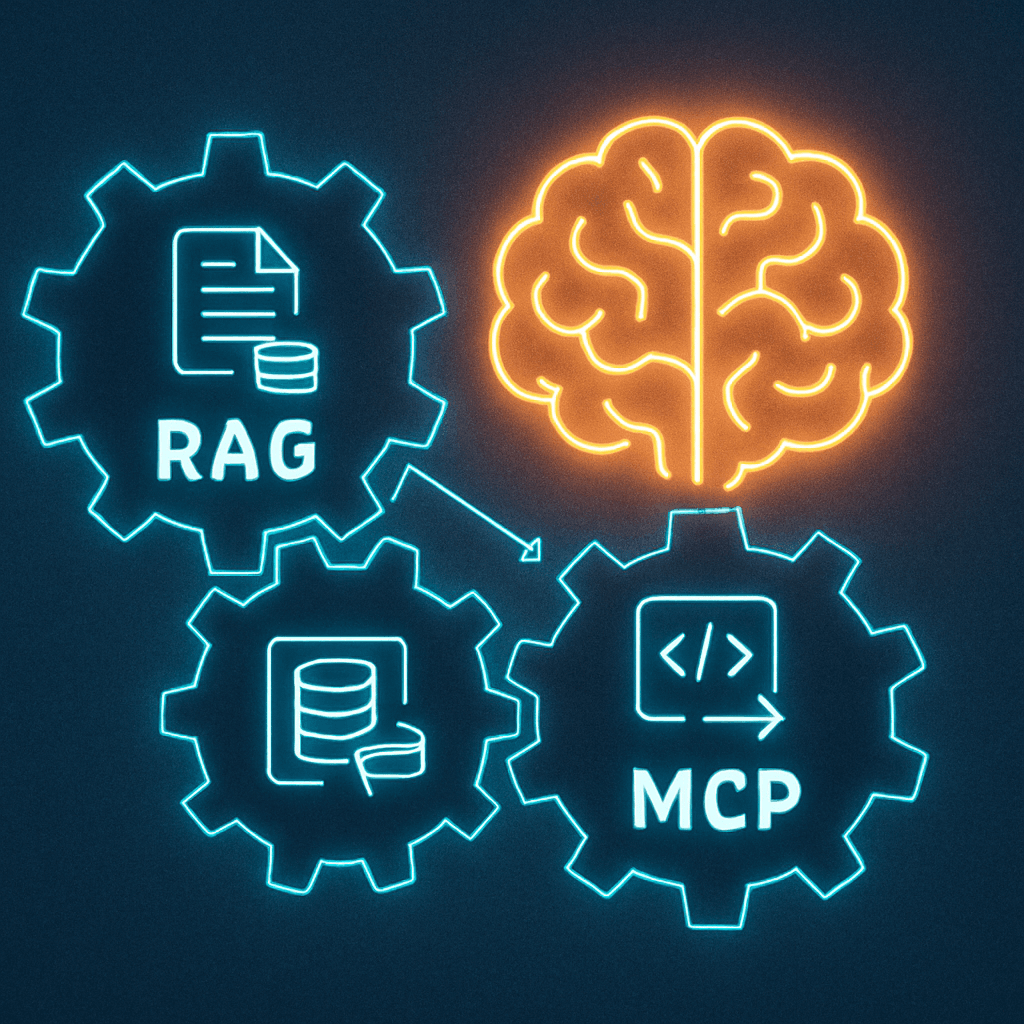
Beyond the Buzzwords: Supercharging AI with the Powerful Combination of MCP and RAG
Large Language Models (LLMs) are revolutionizing how we interact with information, but they have inherent limitations. An LLM's knowledge is typically frozen at the point its training data was collected, and it lacks the ability to interact with live, external systems. To address these challenges, two powerful methodologies have emerged: Retrieval-Augmented Generation (RAG) and the Model Context Protocol (MCP). While distinct, their true potential is unlocked when used in tandem, creating AI systems that are not only knowledgeable but also capable of taking meaningful action.
Understanding the Core Concepts
At its heart, Retrieval-Augmented Generation (RAG) tackles the knowledge gap. It provides a mechanism for an LLM to access and incorporate up-to-date, external information before generating a response. Think of it as giving your AI a library card to a vast, constantly updated collection of documents. When a query is made, the RAG system retrieves relevant information from a knowledge base and provides it to the LLM as context, leading to more accurate and factually grounded answers. This process helps to significantly reduce the risk of "hallucinations," or the generation of plausible but incorrect information.
The Model Context Protocol (MCP), on the other hand, addresses the action gap. It's a standardized framework that enables an LLM to interact with external tools and APIs. You can think of MCP as a universal remote control for your AI, allowing it to perform tasks like creating a support ticket, sending an email, or updating a customer's information in a CRM. This transforms the LLM from a passive information generator into an active participant in digital workflows.
The Synergy of RAG and MCP
While RAG provides the "what" (the knowledge), MCP provides the "how" (the ability to act). The combination of these two approaches creates a powerful symbiotic relationship where the whole is greater than the sum of its parts.
Consider a sophisticated customer service AI. It could leverage RAG to access a comprehensive knowledge base of product manuals and troubleshooting guides to answer a user's question about a malfunctioning device. Then, if the issue requires a repair, the AI could use MCP to create a support ticket and schedule a service appointment, all within the same conversation.
This synergy also extends to more complex, multi-step workflows. An AI-powered marketing assistant could use a RAG tool to research past successful campaigns and competitor analysis. Based on this retrieved information, it could then use other MCP tools to draft social media posts and schedule them through a social media API.
Real-World Applications
The combined power of RAG and MCP is already being applied across various industries:
- Healthcare: An AI assistant for doctors could use RAG to retrieve the latest medical research and then use MCP to access a patient's electronic health record to provide contextually relevant insights.
- Finance: A financial advisor bot could employ RAG to get real-time market data and news, and then use MCP to execute trades through a user's brokerage account.
- Sales Intelligence: A sales agent can utilize RAG to pull up marketing materials and competitor information, while using MCP to fetch a customer's history from a CRM, providing a comprehensive view for more effective sales conversations.
The Future is Multimodal
The evolution of this powerful duo is heading towards Multimodal RAG, which enhances the reasoning capabilities of language models by incorporating diverse data sources like images, diagrams, and structured data. Imagine an AI that can not only read a textual description of a problem but also analyze a photo of a warning light in a car to provide a more accurate diagnosis. This multimodal approach, combined with the actionable capabilities of MCP, promises even more sophisticated and human-like AI interactions in the near future.
In conclusion, while RAG and MCP are powerful in their own right, their integration marks a significant leap forward in the development of intelligent and autonomous AI systems. By bridging the gap between knowledge and action, this combination is paving the way for AI that can not only understand our world but also actively and meaningfully participate in it.