What is Generative AI?
Generative AI is a form of artificial intelligence that can create new content on its own. This can be text, but also images, sound, code, or even presentations.
A simple definition: Generative AI uses existing data to create something new that resembles human work.
Examples include Chatbots that write emails or responses (like ChatGPT), Image generators, AIs that automatically generate scripts or source code.
What are Large Language Models (LLMs)?
A Large Language Model (LLM) is an algorithm trained on vast amounts of text – from books and news articles to Wikipedia and internet forums. Through this training, the model learns how language works: sentence structure, semantics, context, nuance.
Well-known examples of LLMs are GPT-4 (OpenAI), Claude (Anthropic), Llama 3 (Meta), Gemini (Google), and the open-source variant Deep Seek.
These models are powerful because they not only understand language but can also generate it. Whether it's policy advice, legal text, or a summary of an annual report – they do it incredibly fast.
How does an LLM work under the hood?
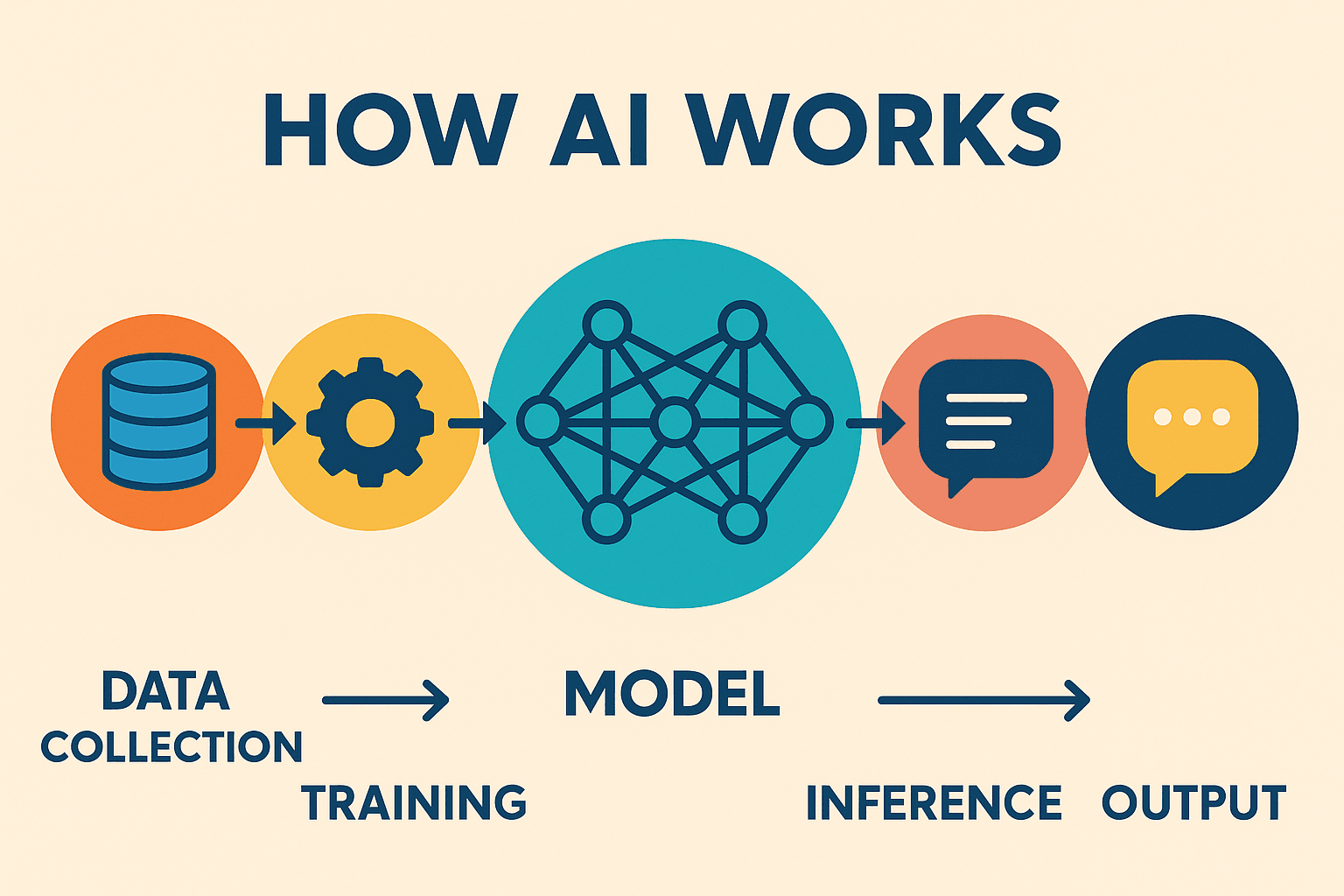
LLMs predict the next word based on everything that preceded it. That sounds simple, but the scale makes it revolutionary. By analyzing hundreds of billions of words, they can learn to recognize grammar, logic, and even subtle humor.
An example:
- Prompt: "Write a summary of a risk report in clear language."
- Output: A neat, understandable text of five paragraphs – often in seconds.
At their core, they are neural networks – specifically: transformer architectures – consisting of millions to billions of parameters. These parameters encode relationships between words, concepts, and patterns.
What do organizations use generative AI for?
At PrudAI, we see organizations using generative AI for:
- Utilizing unstructured data: AI helps convert documents, videos, etc., into structured data that can be better utilized. Many documents, reports, videos, etc., contain a lot of information. Much of that information remains unused because employees cannot find it. AI helps unlock the information without employees having to search the files. For example, in a company, processes, written work instructions, and video explanations can be used to provide employees with a ready-made answer to the question of how to do something, instead of having to search the documents themselves, rewatch videos, etc. This leads to a significant increase in efficiency, but also in job satisfaction. The less enjoyable search work is done by AI.
- Handling large and complex amounts of data: AI is linked to internal systems such as Sharepoint, case systems, financial systems, maintenance systems, etc., allowing insights to be easily generated by combining data from different systems. For example, provide an overview of all contracts and check the payments in the financial system. Once AI is connected as the beating heart of the organization with various systems, questions can be easily asked via text or speech that are quickly answered.
- Decision support: AI helps structure choices, map scenarios, or conduct risk analyses. AI can indicate to what extent a proposed decision contributes to the objective or suggest that other alternatives might be more effective or cheaper.
- Automation of tasks: Agents (= employee, but digitally) provide extra capacity to perform tasks. In times of scarce personnel, numerous tasks can be performed by agents. A virtual organization of agents can also be built to support the real organization. This virtual organization is managed by the Chief Executive Agent (CEA) developed by PrudAI, who, together with the CEO, manages the entire organization.
Are there risks?
Certainly. Generative AI is powerful, but not infallible. Models can:
- Provide incorrect or outdated information
- Hallucinate (invent things that sound logical but are not correct)
- Reproduce information without citing sources
- Contain bias and stereotypes
There are several ways to mitigate these risks, including:
Human in the loop (always have an expert review - four-eyes principle)
Use validated data - we use as much own data as possible (own documents and data from our own linked systems, internet use of only an approved list of websites, etc.)
LLM as a judge - the four-eyes principle can also be performed by AI by having one AI check the other.
Deep reasoning - have AI determine its answer multiple times so it knows the answer is correct. It may take a bit longer to get an answer, but the outcome is more reliable.
What makes an LLM 'intelligent'?
Intelligence in LLMs is statistical, not conscious. The model "knows" nothing but is extremely good at predicting logical language use. Yet it often feels like you're talking to a person – that's precisely the strength and the danger.
Think of it as a hyper-intelligent parrot: it doesn't just repeat, it cleverly reconstructs based on context and pattern recognition.
Conclusion: Generative AI changes the game – but use it wisely
Generative AI and LLMs offer enormous opportunities. But without clear frameworks, quality control, and ethical awareness, you risk errors, reputational damage, or even legal issues.
At PrudAI, we believe in AI that enhances people – not replaces them. We help organizations use generative AI smartly and responsibly. From experimentation to integration.