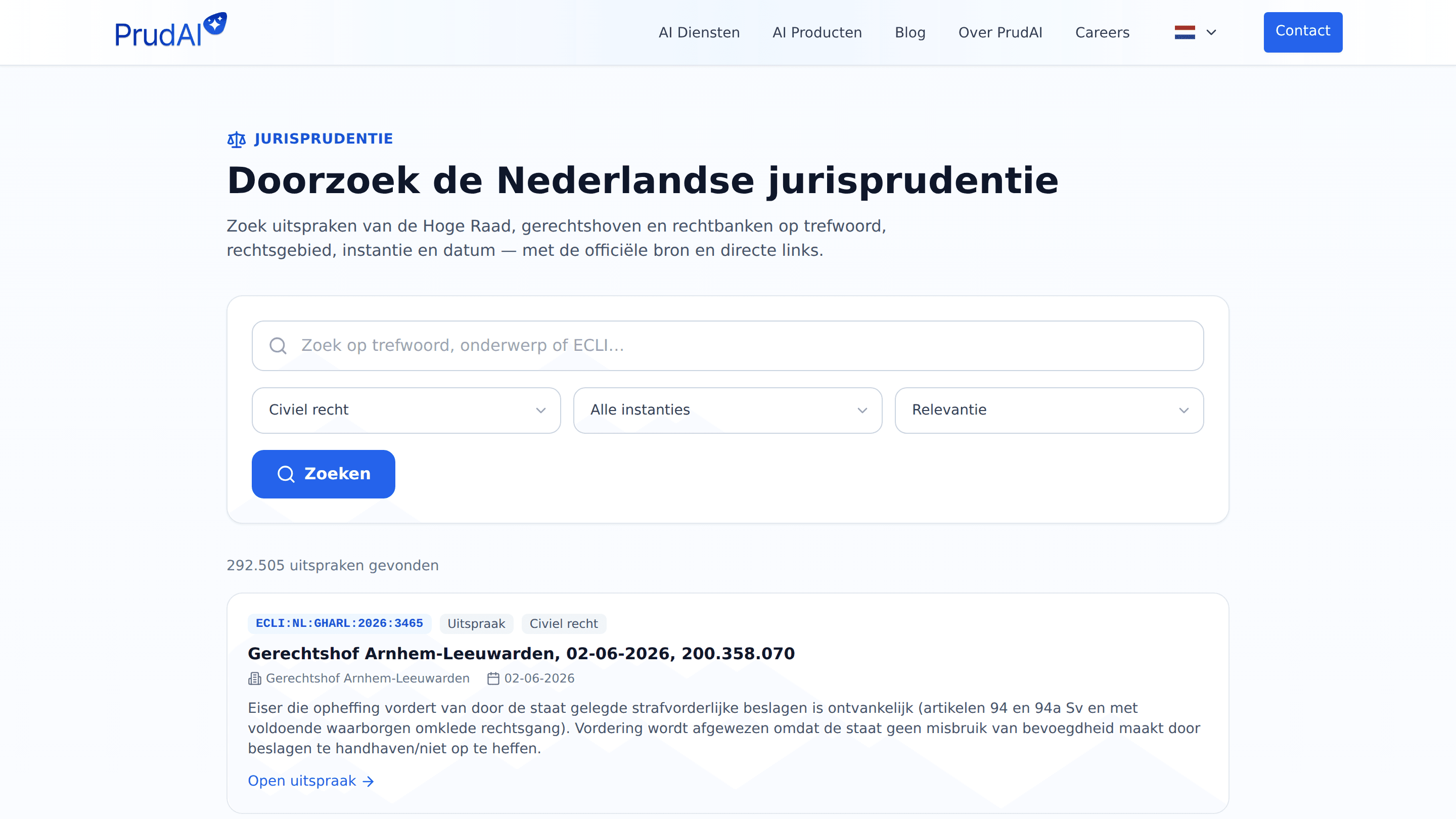
Ask an AI assistant for a Dutch Supreme Court ruling and you'll often get back a plausible-looking ECLI that doesn't exist. For a lawyer that's useless, and dangerous.
The problem isn't the model; it's the connection to the source. There was no ready-made, open way to connect AI agents to the official Open Data of the Dutch judiciary (Rechtspraak). So we built one, and open-sourced it.
rechtspraak-mcp
rechtspraak-mcp is an open-source connector (MIT) built on the Model Context Protocol. Any MCP-compatible assistant (Claude, Cursor, and more) can use it to:
- search Dutch case law (by legal area, court and date);
- fetch the full text by ECLI, straight from the official source;
- see the formal relations between rulings (conclusie, cassation, citations).
No API key. One command: npx rechtspraak-mcp. It's on npm, in the official MCP registry, and on GitHub.
Why open source?
Reliable access to public legal sources shouldn't be a walled garden. Everyone in the Dutch legal-tech ecosystem may build on it, competitors included. The hard part (turning a raw ruling into a sourced answer a lawyer can trust) is what we build LEO for. Open infrastructure, closed where it adds value.
Try it
Search Dutch case law at prudai.com/jurisprudentie, or read the code at github.com/Prudai/rechtspraak-mcp.