AI in personal injury law can take over a lot of the legwork: sorting medical records, listing heads of damage and finding comparable judgments. It cannot take over your judgement. Before anything leaves the firm, the lawyer checks every source, every amount and every medical conclusion personally. That follows from the core values of the Dutch legal profession and from the NOvA recommendations on AI.
In short
- AI helps with sorting and listing: a medical timeline, a first draft of the statement of damages, comparable awards for pain and suffering.
- The lawyer decides. You check amounts, causation and medical conclusions yourself, against the documents.
- In December 2025 the NOvA, the Netherlands Bar Association, issued recommendations, not a guideline. The core: always check citations, case law and facts yourself.
- Medical records contain health data. Only put them into a tool with strong safeguards.
- In July 2026 a Dutch lawyer received a reprimand, partly over AI-generated case references the lawyer had not checked. That risk exists in every area of law.
Where does AI help in a personal injury case?
Mainly in work that involves a lot of reading and sorting. A personal injury file often runs to hundreds of pages: GP records, specialist letters, expert reports, payslips and annual income statements.
AI can give that material a first structure: a timeline of complaints and treatments, an overview of heads of damage, or judgments involving similar injuries. It does not produce a conclusion you can adopt unchecked.
AI proposes, the lawyer decides. The larger the amount or the heavier the medical question, the stricter the check.
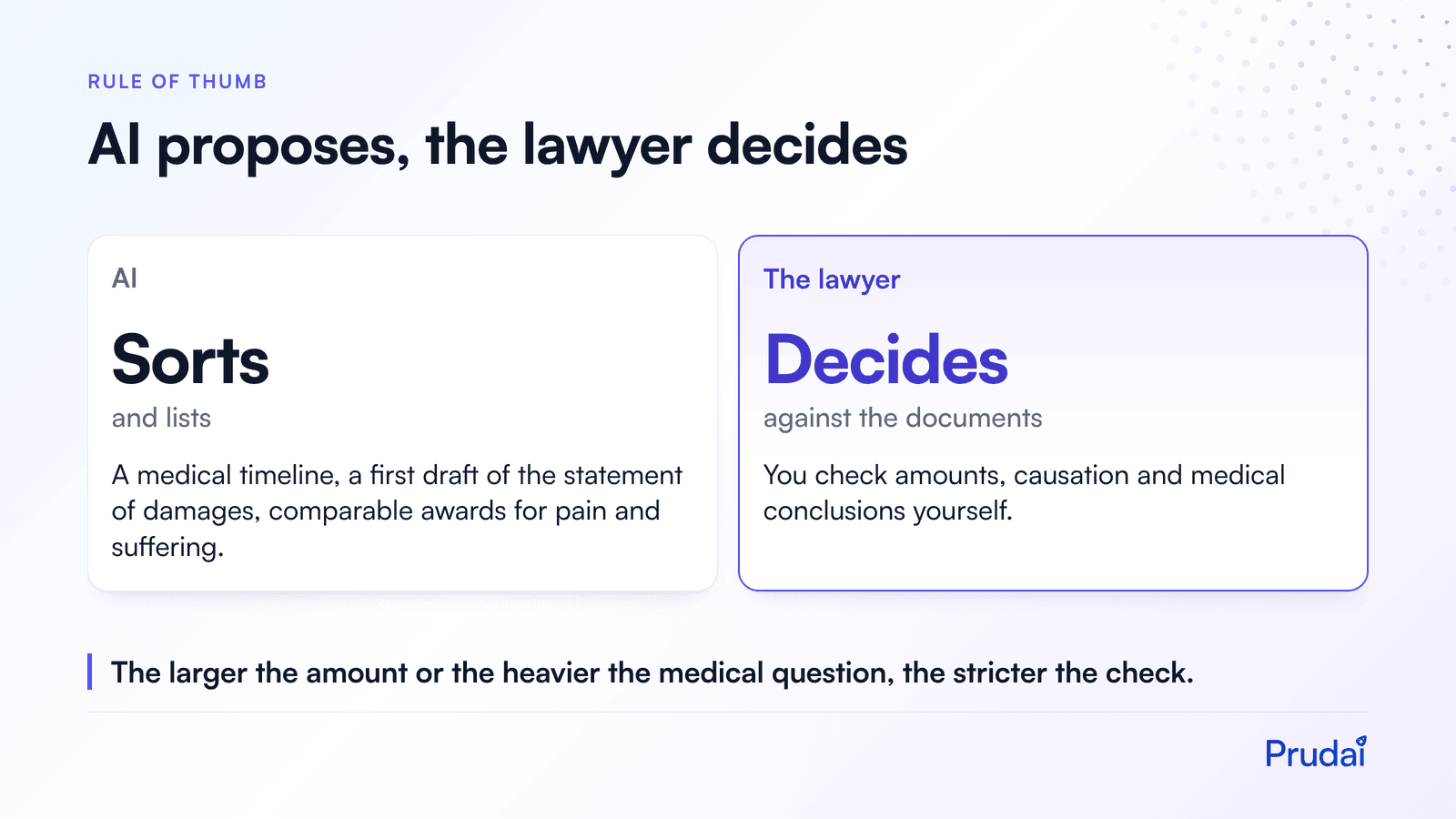
Comparison: AI sorts and lists (medical timeline, first draft of the statement of damages, comparable awards); the lawyer decides and checks amounts, causation and medical conclusions personally.
What should a personal injury lawyer check personally?
Everything that ends up in a letter, a statement of damages or a court document:
| Component | Where AI helps | What you check yourself |
|---|---|---|
| Medical file | A timeline of complaints, treatments and limitations | Is every line really in the medical record, with the right date? |
| Causation | Listing arguments for and against | The judgement on the link between accident and complaints rests with you and the medical adviser |
| Heads of damage | An inventory per head, with the relevant Letselschade Richtlijn | Does the guideline apply, and is the amount or calculation method still current? |
| Loss of earning capacity | Collecting data from payslips and income statements | The assumptions, the scenarios, the capitalisation and every amount |
| Pain and suffering | Finding cases with similar injuries | Is the injury really comparable, and does the judgment say what is claimed? |
| Case law and legislation | Finding judgments and provisions | Open and read every judgment and every provision in the version in force |
What do the NOvA recommendations say about AI in personal injury cases?
Nothing specific to personal injury, but much that applies. In December 2025 the NOvA published its Recommendations on AI in legal practice (Aanbevelingen AI in de advocatuur). They are not a guideline and not a rule of professional conduct. The NOvA offers them as direction.
Two points weigh heavily in personal injury work. Under "Always verify the output" the NOvA says: check citations, case law and facts by hand before use. It also asks lawyers to use only tools that cite their sources, so the output can be verified. Under integrity it is shorter still: never adopt AI output without checking it.
The recommendations carry no sanction of their own, but the disciplinary courts do apply the core values. In July 2026 a lawyer was reprimanded, partly because AI-generated references to judgments did not exist or pointed to other judgments. That happened in two tenancy cases, but the lesson applies to every practice. What the court said is set out in disciplinary law and AI references. The full framework is in our overview of NOvA guidance on AI use in Dutch law firms.
Can you put a medical file into an AI tool?
Only with strong safeguards. Medical records contain data concerning health. Under Article 9 GDPR, processing such data is prohibited in principle. There are exceptions, such as processing that is necessary for a legal claim. That does not make every tool suitable.
The NOvA is specific. Do not use confidential data in free tools, and do not enter client data into public AI models. Share only what is strictly necessary. Carry out a DPIA when you process personal data; that is an advance assessment of the privacy risks. In addition, Article 28 GDPR requires a data processing agreement with a vendor that processes personal data on your behalf.
Healthcare providers protect such data under their own standard: see NEN 7510 explained.
How it works at Prudai
We build LEO, an AI assistant for lawyers. For personal injury, this is how it works and where the limits are.
Specialist sources. When you select personal injury as your practice area in LEO, LEO works with sources including De Letselschade Richtlijnen, the Gedragscode Behandeling Letselschade with its Medische Paragraaf, and the Rotterdamse Schaal.
Four workflows. For personal injury there are four workflows: liability analysis (Aansprakelijkheidsanalyse), medical file chronology (Medisch-dossier-chronologie), statement of damages (Schadestaat-opbouw) and pain and suffering benchmarking (Smartengeld-benchmarking). In the statement of damages workflow, a medical and a financial document analyst work first, followed by a damages calculator, a reviewer and an editor. These are AI roles. The damages calculator helps with the arithmetic; you determine the statement of damages. In the liability analysis, an opposing role argues as the other party would, intended to bring weak spots to light sooner.
First a plan, then your approval. All four first present a plan. For liability analysis and the statement of damages, LEO waits for your approval. For the two inventory workflows, the medical chronology and the pain and suffering comparison, the run continues after four hours without a response. When you take a decision at the gate, LEO records who did so, when and in which round.
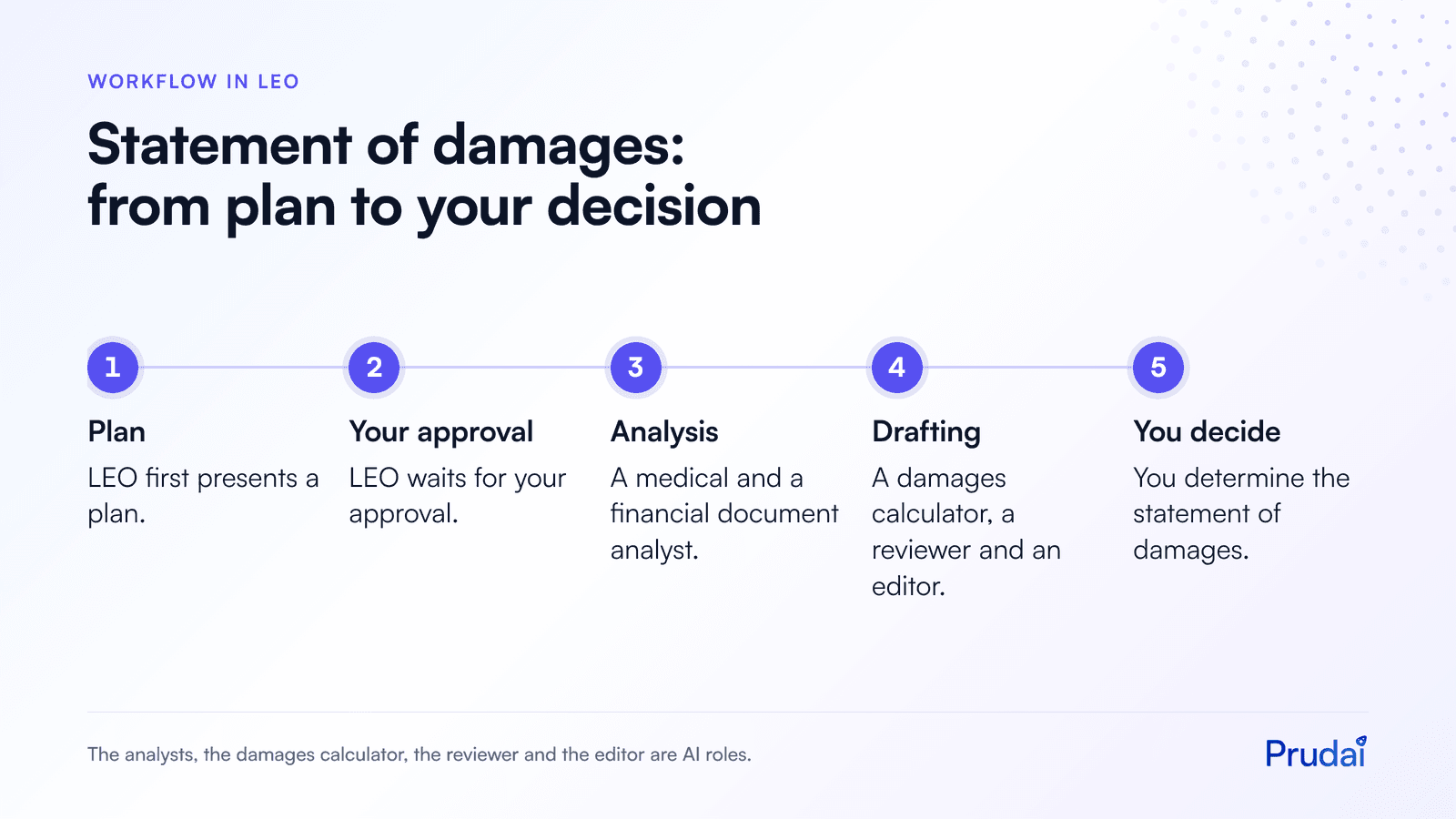
Steps of the statement of damages workflow in LEO: plan, your approval, medical and financial document analyst, damages calculator, reviewer and editor, and you determine the statement. These are AI roles.
A gate for ECLI numbers. In LEO's chat, a gate checks every answer for ECLI numbers (the unique identifier of a Dutch judgment). If an answer cites an ECLI that did not come from a source, a tool or your own documents, the model must retrieve the judgment. If that fails, the answer is visibly marked "unverified". The gate does not check whether the judgment supports your argument. Reading it remains your job.
Why an AI assistant sometimes cites an ECLI that does not exist, and how an open connection to the Dutch judiciary's Open Data helps, is covered in Why AI invents Dutch case law.
Information security. Prudai is certified to ISO/IEC 27001:2022 and NEN 7510-1:2024. The certificate covers our management system, not LEO as a product.
For the specialist
- Book 6 of the Dutch Civil Code (BW). Article 6:95: damage consists of financial loss and other harm, the latter insofar as the law grants a right to it. Article 6:96(2): reasonable costs of establishing damage and liability and of obtaining payment out of court also qualify. Article 6:106(b): compensation for non-financial harm, set on an equitable basis, in case of physical injury. Article 6:107: costs a third party incurred for the injured person and, in case of serious and permanent injury, an amount set by decree for close relatives.
- De Letselschade Richtlijnen. These give a standard way to establish heads of damage, such as household help, do-it-yourself work, study delay and minor injury including pain and suffering. Some contain a standard amount, others a calculation method. Always check the version and indexation in force.
- Who is bound? According to De Letselschade Raad, a self-insured employer is not bound to the GBL and the Richtlijnen through an insurance policy.
- Disciplinary law. In ECLI:NL:TADRSHE:2026:93 (para. 5.6), adopting AI-generated case law without checking breached the core values of competence and integrity and rule 8 of the Dutch rules of conduct. In the same matter, the subdistrict court found a breach of Article 21 of the Dutch Code of Civil Procedure.
- GDPR. Article 9(1) (health data) and 9(2)(f) (legal claims), Article 28 (processor) and Article 35 (DPIA).
Frequently asked questions
May a personal injury lawyer use AI?
Yes. No statute or rule of conduct prohibits it. But you remain personally responsible for every piece of advice and every document, so check every source, amount and medical conclusion yourself.
Can AI calculate a statement of damages?
AI can help with the arithmetic and draft a first version from the documents. The lawyer checks the assumptions and amounts and determines the statement of damages.
May I put medical records into ChatGPT?
Not into a free or public version. Medical records contain health data, a special category under the GDPR. Only use a tool with a data processing agreement and strong safeguards, and share only what is necessary.
Are the NOvA recommendations on AI a guideline?
No. They are recommendations that give direction, not a guideline, regulation or rule of conduct. The disciplinary courts do apply the core values, and the recommendations build on those.
Sources
- NOvA, Aanbevelingen AI in de advocatuur (in Dutch; December 2025, consulted 2 October 2026)
- De Letselschade Raad, Richtlijnen (in Dutch; consulted 2 October 2026)
- De Letselschade Raad, Gedragscode Behandeling Letselschade (in Dutch)
- Dutch Civil Code, Book 6 (in Dutch; consulted 2 October 2026)
- GDPR, Regulation (EU) 2016/679
- Disciplinary Court 's-Hertogenbosch, 27 July 2026, ECLI:NL:TADRSHE:2026:93 (in Dutch)
Would you like to know how LEO works in personal injury cases? See LEO for personal injury lawyers (in Dutch) and request a demo there.
Updated on 4 October 2026