
Sign in with ChatGPT at work: what it means for your compliance
With Sign in with ChatGPT, an employee signs in to another app with their ChatGPT account. If they choose, that app's AI requests then run on their own ChatGPT subscription. It is convenient, but the contract with the model provider then sits with the employee, not with your organisation. Treat it as a new supplier and a new sign-in route, and agree when it is and is not allowed.
In short
- OpenAI announced Sign in with ChatGPT broadly at DevDay on 29 September 2026. ChatGPT Plus and Pro subscribers can use their plan in third-party apps.
- With a personal plan, the employee holds the contract with OpenAI. There is no data processing agreement between your organisation and OpenAI.
- What OpenAI does with these requests (training, retention) is not stated in the developer documentation.
- Under the GDPR, ISO 27001, NEN 7510 and NIS2, this is ordinary supplier management and access management. What is new is how easy it has become.
- Not every provider takes part. Anthropic does not allow third-party apps to sign in with a Claude subscription.
What exactly is Sign in with ChatGPT?
Sign in with ChatGPT has two parts.
- Sign-in. An app uses your ChatGPT account as your identity, just like "Sign in with Google" or "Sign in with Microsoft".
- Plan usage. This part is optional. The app's AI requests then run on the user's ChatGPT subscription, so the app needs no OpenAI API key of its own. OpenAI calls this plan usage or token sharing.
According to OpenAI, the app gets no access to the user's conversations in ChatGPT itself. The user decides per app how much of their allowance it may use. At launch, OpenAI named sixteen partners, including Notion, Vercel and Devin. For commercial apps it is still a limited trial with selected partners.
Two limits matter:
- Plus and Pro only. At launch this covers the personal Plus and Pro plans. OpenAI does not mention Business or Enterprise here.
- Paid apps need approval first. Open-source projects and apps someone runs locally for themselves can offer plan usage straight away. A paid or hosted app must first request access (through an interest form or waitlist) and may only offer it once OpenAI approves the app.
Why is Sign in with ChatGPT a compliance question?
With plan usage, the contract with the model provider sits with the employee. The processing therefore falls outside the agreements your organisation has made itself. The three routes side by side:
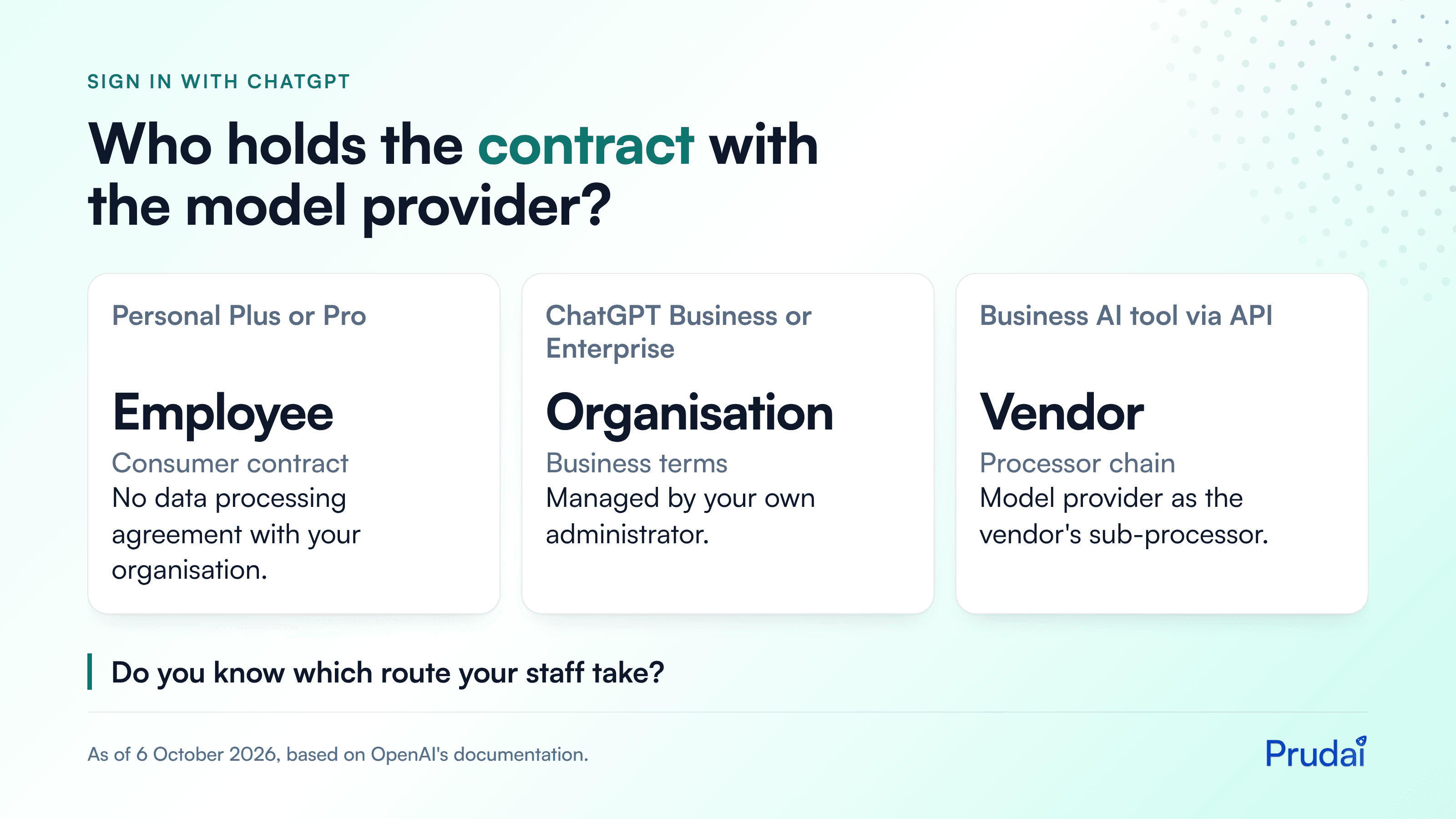
Comparison of three routes to an AI model: personal Plus or Pro, ChatGPT Business or Enterprise, and a business AI tool via the API, showing for each route who holds the contract with the model provider
| Personal Plus or Pro | ChatGPT Business or Enterprise | Business AI tool via the API | |
|---|---|---|---|
| Contract with OpenAI | The employee | Your organisation | The tool's vendor |
| Data processing agreement | None with your organisation | With OpenAI | With the vendor; the model provider is a sub-processor |
| Training on content | On for ordinary chats unless the employee turns it off; not described for plan usage | Off by default | Depends on the contract; off by default for OpenAI's API |
| Who manages access? | The employee | Your administrator | Your administrator, through the tool |
What does the GDPR say?
If another party processes personal data for you, it must offer sufficient guarantees and you record the arrangement in a data processing agreement (Article 28 GDPR). With a personal plan, there is no such agreement: the employee has a consumer contract with OpenAI.
If data about clients or patients ends up in such a request, that can be a personal data breach. The Dutch Data Protection Authority (Autoriteit Persoonsgegevens) warned about this in August 2024, after reports of employees entering personal data into AI chatbots on their own initiative. Sign in with ChatGPT shortens that route. The employee no longer copies and pastes anything: the app they already use sends the work on by itself.
What do ISO 27001 and NEN 7510 require?
Both standards require you to manage suppliers and cloud services and to know who has access to what. In ISO/IEC 27001:2022 this concerns the controls for supplier relationships (5.19 to 5.22), the use of cloud services (5.23) and identity and access management (5.15 to 5.18). NEN 7510-1:2024, the Dutch standard for healthcare, is based on ISO/IEC 27001:2022; the healthcare controls are in NEN 7510-2:2024.
Signing in with a personal ChatGPT account means an account outside your own identity management. When an employee leaves, you disable their work account. Their personal ChatGPT account stays linked to the app.
Does this apply under NIS2 as well?
Yes. If your organisation falls under NIS2 (in the Netherlands, the Cyberbeveiligingswet), supply chain security is part of your duty of care (NIS2 Directive, Article 21(2)(d)). An AI service that employees sign in to themselves is a link in that chain too. How to assess that chain is covered in our article on NIS2 supply chain security.
And the AI Act?
Since 2 February 2025, organisations that use AI must take measures to ensure, to their best extent, a sufficient level of AI literacy among their staff (Article 4 AI Act). An employee who knows when to link their own subscription to an app, and when not to, is part of that. More in AI literacy under the EU AI Act.
What is not (yet) in the documentation?
OpenAI's developer documentation (consulted on 6 October 2026) does not say:
- whether the content of these requests is used to train models;
- how long OpenAI keeps requests and responses;
- whether a data processing agreement covers this route, and in which region processing takes place;
- whether and when Business and Enterprise will join, and what administrators can then configure.
For ordinary chats: with Plus and Pro, OpenAI may use content to improve its models unless the user turns this off ("Improve the model for everyone"). With Business, Enterprise and the API, that does not happen by default. Whether this also applies to plan usage in other apps, OpenAI does not say. Until it is in writing, the safest assumption is that the consumer terms apply.
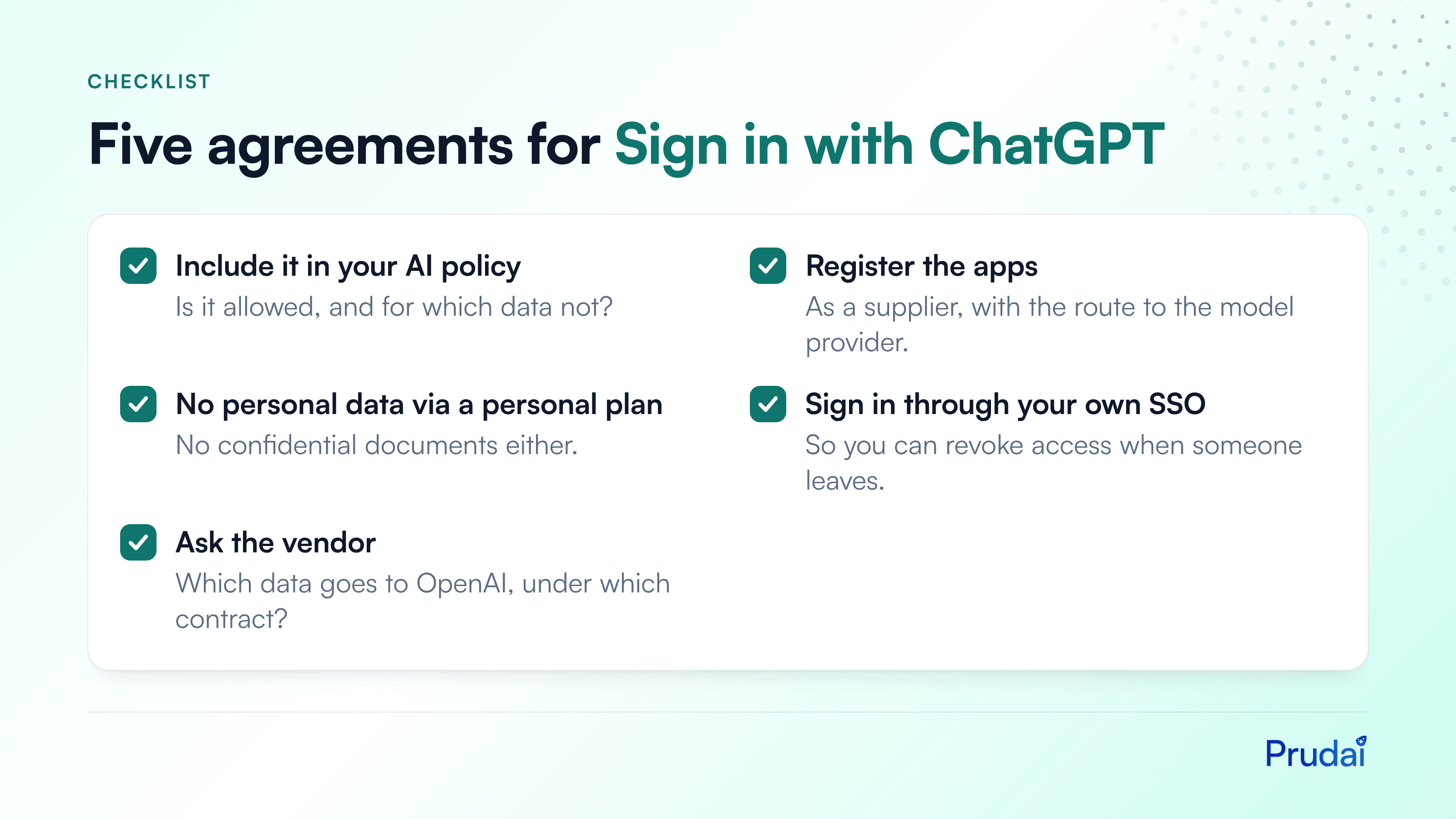
Which agreements should you make now?
Checklist of five agreements for Sign in with ChatGPT: include it in the AI policy, register the apps, no personal data via a personal plan, sign in through your own SSO, and ask the vendor
- Include it in your AI policy. May staff link their own subscription, and for which data not?
- Register the apps. Put apps that offer Sign in with ChatGPT in your supplier or application register, including the route to the model provider.
- No personal data via a personal plan. No confidential documents either. Public information is a different matter.
- Sign in through your own SSO. Where possible, route business apps through your own identity management, so you can revoke access when someone leaves.
- Ask the vendor. What happens when a user links their ChatGPT subscription? Which data goes to OpenAI, and under which contract?
If health data or large-scale processing is involved, check whether you need a DPIA (Article 35 GDPR).
Does every AI provider do this?
No. Anthropic, the maker of Claude, rules it out in the Claude Code documentation. Developers may not offer sign-in with a Claude account in their apps, nor route requests on behalf of their users through a Free, Pro or Max plan. Anyone who wants to use Claude in their own product does so through the API or a cloud provider, under a business contract. Whether an app can work with your own subscription therefore differs per provider. Check it per app.
How we handle it at Prudai
When OpenAI announced Sign in with ChatGPT, we looked at whether it fits our products. Our standing rule applies: before a model can go into production with us, it has to pass our compliance gate. That gate requires contractual EU processing, an acceptable chain of processors and no vendor-mandated data retention that cannot be switched off, such as the 30 days Anthropic requires for Claude Fable. Which models pass and which do not is on our PrudentBench page.
Plan usage through a personal subscription bypasses that gate. The request then runs under the user's contract, not ours. As long as OpenAI has not put in writing what happens to these requests, we therefore do not offer it.
That fits how we work. Prudai is certified to ISO/IEC 27001:2022 and NEN 7510-1:2024. A route whose processing we cannot point to does not belong in that.
For your own organisation, it helps to see everything in one chain. In IRMA, suppliers and contracts sit alongside your record of processing, DPIAs, risks and controls. You add an app with Sign in with ChatGPT there as a supplier, with the processing and the risk next to it.
For the specialist
- Scopes. For sign-in only, an app requests
openid profile email. For plan usage it addsoffline_access,resource.invokeandchatgpt.tokens.use.direct. Because ofoffline_access, the app gets renewable access. It can keep working on the subscription after sign-in, until the user revokes the link. Include that in your periodic access review. - Responses API only. Plan usage applies only to requests to OpenAI's Responses API, with limits (for example no transcription or file upload, and
store: falseis required). Other providers fall outside it. An app that uses several models therefore sends part of the work through your subscription and part through its own contracts. - Roles under the GDPR. Your organisation remains the controller for what employees do with personal data in their work. With a personal plan, OpenAI works under the consumer terms and privacy policy of the employee. There is no data processing agreement with your organisation (Article 28(3) GDPR), so you cannot use OpenAI as your processor along this route. Record in your policy or DPIA how you deal with that.
Frequently asked questions
May an employee use their own ChatGPT subscription for work?
You decide that in your AI policy. Without agreements, there is no data processing agreement between your organisation and OpenAI. For public information the risk is small. For personal data and confidential documents it is not advisable.
Is Sign in with ChatGPT the same as ChatGPT Business?
No. ChatGPT Business is a business subscription that your organisation takes out and manages. Sign in with ChatGPT is a way to sign in to other apps. At launch, OpenAI only mentions Plus and Pro; whether Business and Enterprise workspaces will take part is not stated.
Does OpenAI train on what an app sends through my subscription?
The developer documentation does not say. For ordinary chats on Plus and Pro, OpenAI may use content to improve its models unless you turn this off in the settings. Until there is clarity, assume this may apply here too.
Can I sign in to other apps with my Claude subscription?
No, with one exception. Anthropic does not allow developers to offer sign-in with a Claude account or to route requests through a Free, Pro or Max plan. Only in a service that runs the unmodified Claude Code may you sign in with your own Claude subscription. Other apps use Claude through the API or a cloud provider.
What goes in my supplier register?
The name of the app, whether it offers Sign in with ChatGPT, which data passes through it, and under which contract the model provider works. Note whether employees may link their own subscription.
Sources
- OpenAI, Sign in with ChatGPT: ChatGPT plan usage (consulted 6 October 2026)
- OpenAI, Sign in with ChatGPT: quickstart (consulted 6 October 2026)
- OpenAI, Sign in with ChatGPT: registration and sign-in (scopes) (consulted 6 October 2026)
- OpenAI, Sign in with ChatGPT: preview limitations (consulted 6 October 2026)
- OpenAI Cookbook, Integrating Sign in with ChatGPT in your open-source app (consulted 6 October 2026)
- OpenAI, How your data is used to improve model performance
- SecurityBrief, OpenAI launches ChatGPT sign-in for 16 partner tools (2 October 2026)
- The Star, OpenAI expands ChatGPT with apps and third-party sign-in (4 October 2026)
- Dutch Data Protection Authority, Caution: use of AI chatbot may lead to data breaches (August 2024)
- General Data Protection Regulation (GDPR), Articles 28 and 35
- AI Act, Regulation (EU) 2024/1689, Article 4
- NIS2 Directive (EU) 2022/2555, Article 21
- Anthropic, Claude Code: Legal and compliance (consulted 6 October 2026)
Want to know how to keep suppliers, processing activities and AI applications in one register? Take a look at IRMA, or read how to arrange AI literacy in your organisation.
Updated on 6 October 2026
Photo via Pixabay