Virtual Management Assistant at a Consulting Firm
A mid-sized consulting firm struggled to quickly extract insights from their mountain of documents and data. Client reports often took employees weeks, and decisions frequently had to be postponed until the right information was gathered. With PrudAI's Chief Executive Agent (CEA) – a virtual executive directing collaborative AI 'agents' – the organization can now perform complex analyses and tasks within seconds. Where previously a team would spend days drafting a report, the CEA now generates a solid first draft within minutes. This drastically speeds up decision-making and allows employees to focus on strategy rather than information gathering and processing.
The Challenge
The consulting firm produces and uses vast amounts of unstructured data: research reports, Excel models, expert reports, emails, and more. Employees lost a lot of time manually searching archives and combining different data sources to answer client questions. Moreover, knowledge was very person-dependent: if one data analyst was on vacation, another had to start from scratch, or management temporarily missed certain insights. A concrete example: a client requested a comprehensive market trend analysis. Normally, a consultant would first have to contact various internal experts, request data from the research department, and then merge all that input – a process of weeks. In the fast-paced consulting market, such a lead time is actually too long. The management sought a solution to access information and make decisions faster, regardless of the availability of individual employees.
Our Solution
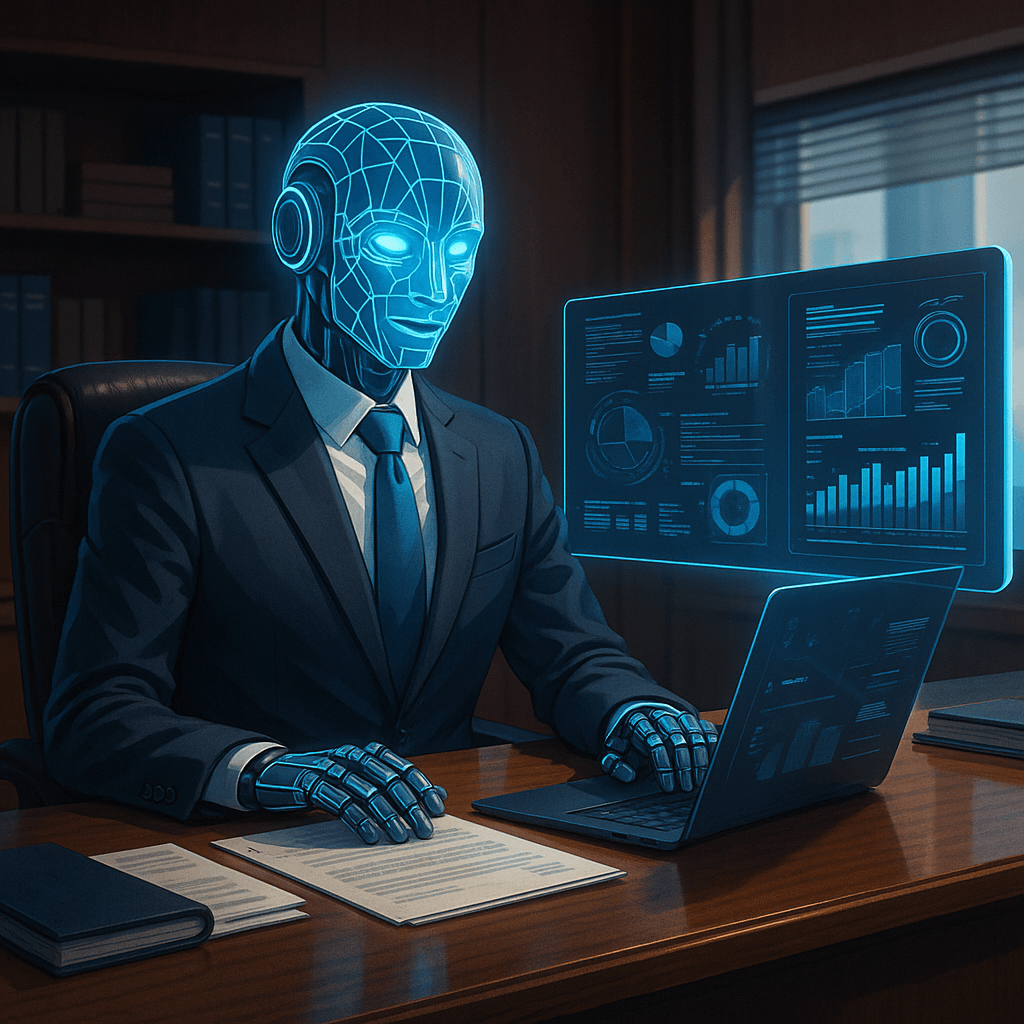
PrudAI introduced the CEA (Chief Executive Agent), an AI system that acts as a virtual management assistant. The CEA is not a single AI, but directs a team of specialized AI agents that collaborate as if they were digital employees. First, all relevant business information was connected: internal reports, databases, minutes, and external sources (think market data subscriptions) were made accessible to the AI through connectors and crawlers. Then the CEA was trained to understand typical management questions and tasks. When a user (such as a manager or consultant) now has a request – for example, 'Provide an overview of the main trends in sector X and draft a concept report with recommendations' – the CEA gets to work. In the background, the AI plans the work and breaks it down into subtasks: an analysis agent searches internal and external data for relevant statistics and articles, a writing agent drafts texts and visuals, and a control agent checks the findings for consistency. These sub-agents work in parallel and consult with each other if necessary. Thanks to the latest generative AI, such agents can independently plan actions, use tools (such as databases or a web browser), and correct each other. McKinsey describes that generative AI agents are capable of independently performing tasks, learning from feedback, and effectively acting as 'virtual colleagues' that seamlessly collaborate with humans. In this case, the CEA behaves like the CEO, but for directing the 'digital employees'.
Added value of AI (CEA): The CEA brings several key benefits. First, it operates based on natural language – users can simply type a question or command in their own words, as they would email a colleague. The AI agents interpret this and do not require scripted instructions or programming work to understand what needs to be done. This is a huge breakthrough: normally, automating such a complex workflow would require many hours of coding, but now it can be done with a simple prompt. Generative agent technology makes it possible to automate complex tasks faster and easier, precisely because the AI understands human instructions. Second, the CEA can consult multiple systems and data sources simultaneously. Where an employee might not have access or time to browse all sources, the AI quickly switches between databases, documents, and even web sources to gather information. The result is that more data is included in analyses than was previously possible. This leads to richer insights. Third, the CEA also actually performs actions. Think of sending emails, scheduling appointments, or generating a PowerPoint presentation – all tasks that traditionally require a lot of manual work. For example, after drafting a report, the CEA can immediately create draft emails for clients with the main findings. While the CEO directs the 'real' organization, the CEA directs a virtual organization of AI agents (managerial and executive agents) that perform the tasks. This agent orchestration is comparable to a manager outsourcing work to a team, only now it happens autonomously by AI. The result is that the consulting firm can do things in seconds that previously took weeks, and without additional staff.
Results & Impact
The introduction of the CEA has spectacularly increased the efficiency and effectiveness of the consulting firm. Where an extensive data analysis and report once took two weeks of work from multiple people, the AI now generates a first version within minutes. Of course, experienced consultants still review it for fine-tuning (human in the loop), but their role has shifted to checking and creatively refining rather than spending hours gathering basic information. The average lead time for internal analyses decreased by about 60–80%. As a result, decisions can be made much faster; management has virtually immediate access to the necessary facts. Quality has also increased: because the AI involves all available data, decisions are better substantiated and less based on gut feeling or limited info. A side effect is that knowledge is less silo-bound – even if a certain expert is absent, the CEA can still retrieve the relevant knowledge from their documents. The organization is therefore less vulnerable to staff leave or departure. Employees do not see the CEA as a threat, but as a relief: they spend more time on the creative and interpersonal aspects of their work (advisory conversations, strategy development) and less on the tedious search and compilation work. All in all, this virtual management assistant has made the company more agile; it can respond more quickly to client inquiries and utilize internal information much more effectively. The management sees the CEA as a 'digital colleague' that remains a permanent part of the team.