Where do organizations stand now?
Adoption is broad and accelerating. In 2025, ~78% of organizations say they use AI in at least one function, especially in IT, marketing & sales, and service operations. (Sources: McKinsey 2025)
In the public sector, AI is still less used due to fears of data leaks. Therefore, many organizations have an AI ban. However, governments feel increasingly compelled to regulate AI because there is more and more shadow use. And that's the last thing you want. A Private AI solution would help many organizations move forward.
How AI delivers value today (businesses vs. public sector)
- Businesses: greatest benefits in software development (developer productivity), customer service (faster and more consistent answers), supply chain (demand, purchasing proposals, scenarios), and commercial teams (content, proposals, pricing). This results in shorter lead times and more resilience in pressured chains. We notice it ourselves in our IT development. What a developer does now with AI support, you needed 5 developers for 2 years ago.
- (Semi)public sector: shift from standalone chatbots to case handling, document & policy analysis, proactive services, and supervision/enforcement with clear safeguards (human-in-the-loop, logbooks, bias checks).
From AI to agents, and on to multiple agents
Copilot (AI assistant): supports a human within a single task step (summarizing, editing, code suggestions).
Agentic AI (one agent): receives a goal and executes a plan with actions and feedback loops (e.g., 'process 200 files, request missing information, report progress').
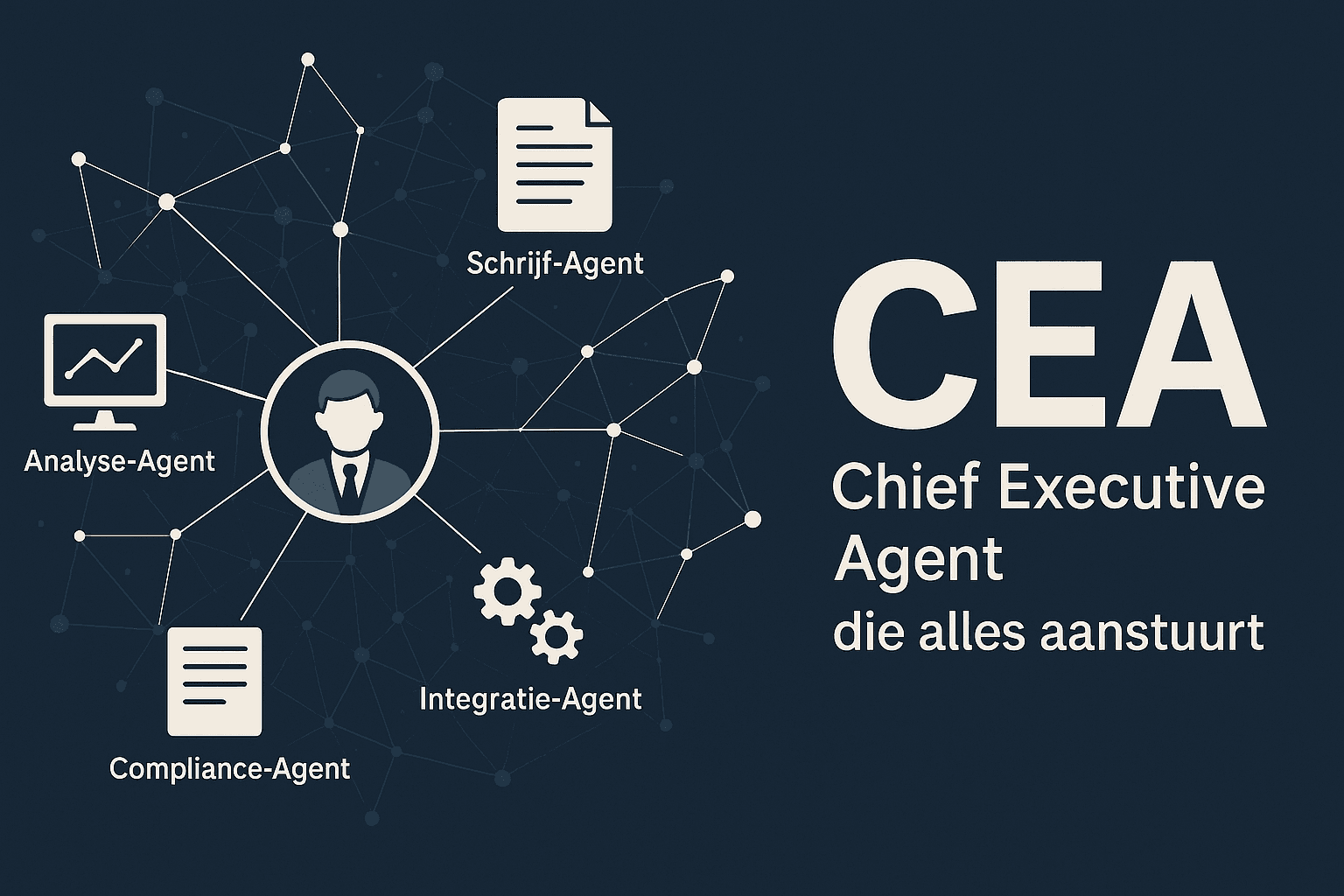
Multiple agents: several specialized agents work together, e.g., an analysis agent, writing agent, compliance agent, and integration agent (ERP/CRM/API's), under the direction of an orchestrator. At PrudAI, we call this director the Chief Executive Agent (CEA).
When to choose what?
- Copilots: quick time savings in existing tasks; low change curve.
- One agent: repetitive work with clear criteria and one source of truth.
- Multiple agents: end-to-end processes with different competencies or 24/7 continuity, 'human in the loop' for exceptions.
Practical experiences (anonymized cases)
- Medium-sized semi-government – case handling & decision preparation. We started with a copilot for minutes and summaries and moved to a processing agent classifying and handling files with review packages (human in the loop) in 3 months. The lead time decreased by ~30–40%; audit trail improved (checklists, documentation, version control).
- Manufacturing company. Manufacturing companies struggle with machine downtime and scarce experienced personnel. Training an internal maintenance technician takes about a year. By incorporating all work instructions, processes, video instructions, fault information, etc., into an AI knowledge base, a technician can immediately access the necessary relevant knowledge, reducing downtime by 25-30%.
- Service company – software delivery. Developers use copilots (code, tests) and a release agent that orchestrates changelogs, security checks, and deployment. Lead time from ideation to release noticeably decreases; quality increases due to consistent checks.
From copilots to agents in 3 months: without risk
- Phase 1: Start and gain experience. Begin with a workshop to explore ideas
- Phase 2: Develop the best idea into a business case and determine what is needed
- Phase 3: Build a Proof of Concept and test with part of the organization(data)
- Phase 4: Develop the PoC into a fully functioning whole
This route quickly delivers results and support. The biggest bottleneck I see in organizations is not technology, but leadership and courage: who owns the outcome and the change? Therefore, it is wise to gain experience in small steps. This significantly limits the risk. Want to know more about a concrete step-by-step plan?
When are you ready for multiple agents?
You are ready when you:
- know the process end-to-end (inputs, decision rules, outputs)
- have API access to core systems
- enforce governance rules in tooling
- have one responsible owner for the outcome (not just 'the model').
The rest is iteration: adding tasks, refining quality standards, training teams to work with agents.
Why now?
- Labor market tightness: agents scale capacity without extra FTE.
- Knowledge loss & double work: unlock knowledge and prevent loss upon retirement (many employees retiring in the coming years) with an AI knowledge base
- Competitive advantage: those who redesign processes with agents see measurable impact faster and are more scalable.
Want to translate this to your organization? I'd be happy to schedule a short Teams session to explore use cases and a 3-month route. Click here to contact us
Sources (selection)
- McKinsey (2025), The State of AI. https://www.mckinsey.com/capabilities/quantumblack/our-insights/the-state-of-ai
- McKinsey (2025), The state of AI: How organizations are rewiring to capture value (PDF). https://www.mckinsey.com/~/media/mckinsey/business%20functions/quantumblack/our%20insights/the%20state%20of%20ai/2025/the-state-of-ai-how-organizations-are-rewiring-to-capture-value_final.pdf
- OECD (2024), Governing with AI (PDF). https://www.oecd.org/content/dam/oecd/en/publications/reports/2024/06/governing-with-artificial-intelligence_f0e316f5/26324bc2-en.pdf
- OECD (2024), Governing with AI: Are governments ready? https://oecd.ai/en/wonk/governing-with-artificial-intelligence
- EU, AI Act (application data). https://digital-strategy.ec.europa.eu/en/policies/regulatory-framework-ai
- EU AI Act, Implementation timeline. https://artificialintelligenceact.eu/implementation-timeline/
- Reuters (2025‑08‑13), Manufacturers turn to AI to weather tariff storm. https://www.reuters.com/business/just-time-manufacturers-turn-ai-weather-tariff-storm-2025-08-13/