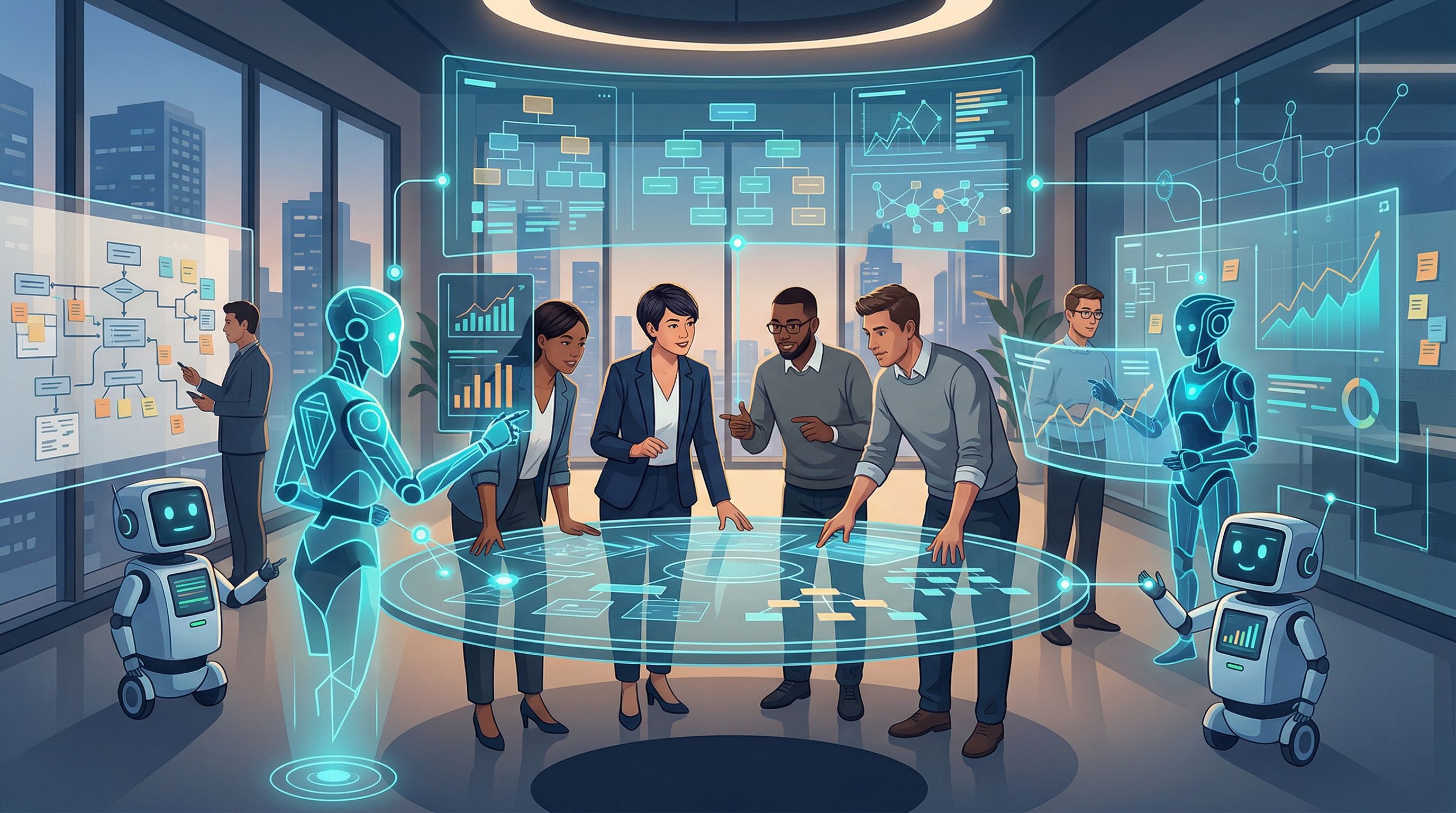
Many organizations still talk about AI as if it were an extra tool layered on top of existing work. In 2026 that picture is becoming too small. Once AI starts scaling seriously, it changes not only the tool stack, but also how teams collaborate, how decisions are prepared, and how responsibility is organized.
McKinsey's The state of AI in 2025 makes clear that broad adoption does not automatically create broad impact. That requires organizations to redesign processes and decision-making. The State of Organizations 2026 points in the same direction: companies are under pressure from technological acceleration, economic uncertainty, and changing expectations of work. That is why the AI-enabled organization is not a futuristic abstraction. It is an operating model question.
From isolated assistance to real collaboration
The first wave of AI use focused on personal assistance: a copilot that drafts, summarizes, or helps someone code faster. That still matters, but it is not the end state. The next step is a workflow in which multiple specialized agents contribute together: one retrieves information, another compares scenarios, a third drafts a response or recommendation, and a human makes the final judgment or intervention.
That changes the nature of work. People are no longer only producing output themselves. They are also orchestrating, checking, and deciding within a partially automated flow. Employees become less pure executors and more supervisors and designers of work.
Three layers of the AI-enabled organization
Organizations that integrate AI well usually design on three levels at once.
1. The individual layer. Employees use AI to search, analyze, write, or structure work faster. The focus here is skills, AI literacy, and safe tooling.
2. The team layer. Teams define where AI sits in the workflow, who checks what, which prompts or instructions are standard, and where escalation happens. This is where real productivity gains start to appear.
3. The organizational layer. Leadership decides which processes matter strategically, which data and models are approved, how success is measured, and how governance works. Without this layer, teams simply experiment in parallel.
Many organizations invest mainly in the first layer. Scalable value appears only when all three support each other.
What leaders need to do differently in 2026
Leadership in an AI-enabled organization is less about approving isolated pilots and more about designing the conditions for repeatable value. Three shifts matter most.
First, leaders need to be explicit about where AI should create value. Not "use AI wherever possible," but: which processes should become faster, where should quality improve, and where should decision-making become stronger?
Second, leaders need to accept that role design will change. Some tasks shrink, while others become more important. Review, exception handling, quality control, workflow ownership, and model selection all grow in relevance. If you look only at time savings, you miss the new work that appears.
Third, leaders need to manage behavior and adoption, not just technology. A powerful system that never lands in day-to-day operations remains a demo. A simpler system that is safe, trusted, and embedded in the team often creates more value.
How teams can work with agents in practice
For teams, AI success often depends on very concrete design choices. Which agent does what? Which inputs are allowed? When is an output only a draft? Who has authority to override it? How is feedback fed back into the workflow?
A practical pattern often looks like this:
- a retrieval or knowledge agent that gathers relevant context;
- a reasoning or comparison agent that structures options;
- a drafting agent that prepares a recommendation or response;
- a human who checks, decides, and adds contextual judgment.
This pattern works in commercial teams, public organizations, and other knowledge-heavy environments. The key is that everyone understands where automation stops and accountability stays human.
Why the operating model matters more than the model itself
A lot of discussion still focuses on model selection: open source or closed, small or large, cloud or private. Those are relevant questions, but not the first ones. First you need to know how work moves through the system. Without an operating model, even strong technology becomes disconnected.
A good operating model defines:
- which processes will be redesigned around AI;
- which people own quality and exception handling;
- which tooling and data are the default standard;
- how risk and escalation are handled;
- how teams learn from mistakes and improvements.
This is also where many pilot programs fail. The model works, but nobody has designed how it becomes part of daily operations.
A mature path for 2026
The strongest organizations do not start with maximum complexity. They select a limited set of workflows where repeatability, knowledge work, and decision points come together. Then they explicitly design collaboration between humans and agents. Only after that do they scale across teams or processes.
That creates a much more realistic growth path. Instead of a grand transformation story without foundations, organizations move through manageable steps where adoption, governance, and value creation reinforce each other.
In 2026 the central question is no longer whether AI replaces jobs or merely supports them. The more useful question is: how do you design work so that people and agents together produce better outcomes than either could on their own?
Want to explore how your organization can help teams, leaders, and AI agents work together in a scalable operating model? PrudAI supports design, governance, and implementation. Reach out through contact or explore AI Services.
Sources
- McKinsey, The state of AI in 2025
- McKinsey, The State of Organizations 2026
- Stanford HAI, AI Index Report 2025