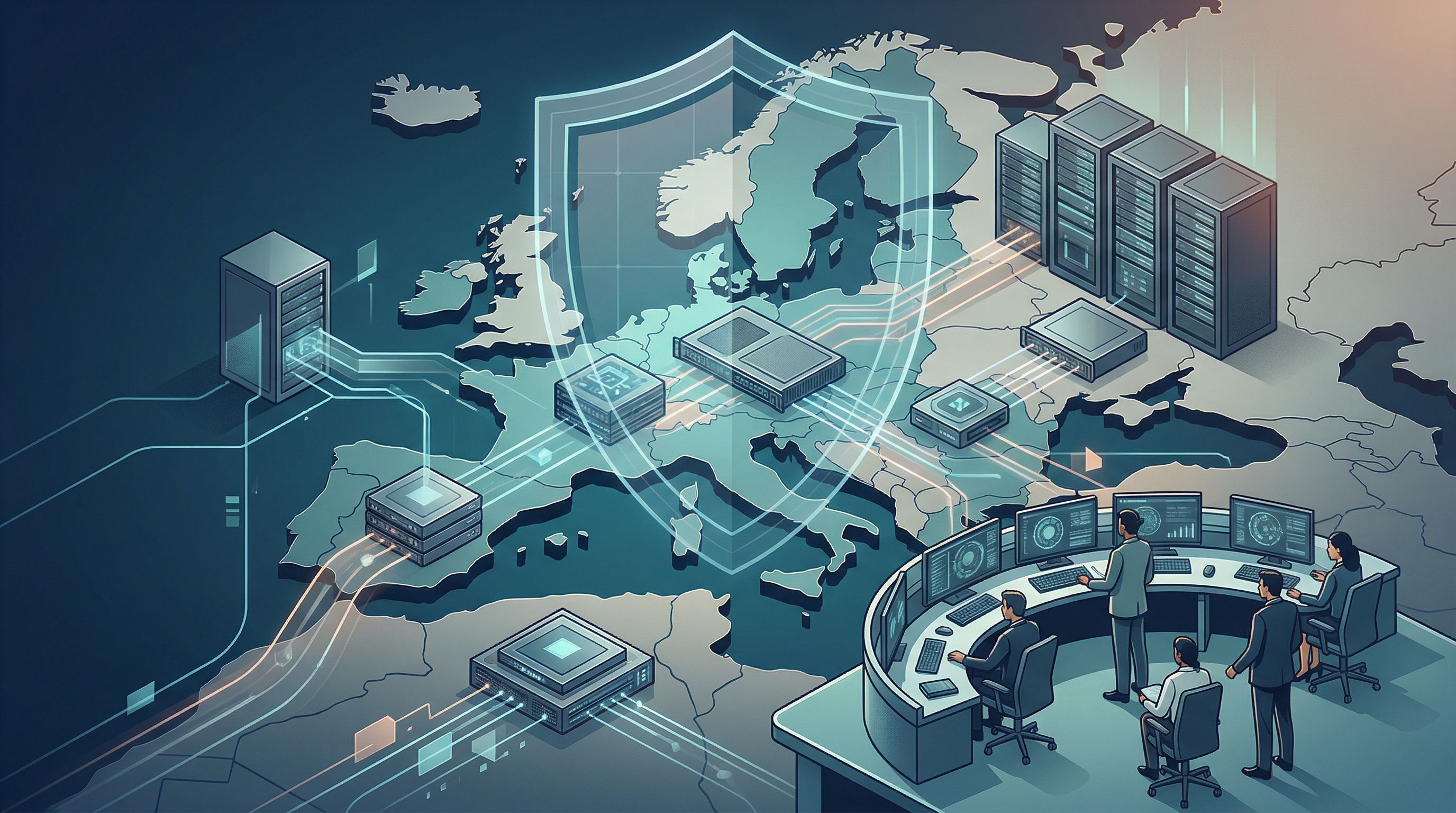
The demand for Private AI is often framed as a response to privacy concerns. That is true, but it is no longer the whole story. For many European organizations, sovereign AI has become a strategic question. It is about control over data, influence over architecture, resilience against supplier dependency, and the ability to deploy AI inside the organization’s own risk posture.
Europe’s direction of travel is becoming more visible. In March 2025, EuroHPC announced that thirteen sites across Europe had been selected to host AI Factories. The goal is not just to support research, but also to give organizations access to high-quality datasets, advanced AI models, and scalable computing infrastructure. That combination brings European autonomy and practical AI adoption closer together.
Why this topic is accelerating
In many organizations, AI use is growing faster than governance. Teams want to work faster, respond to customers more effectively, and unlock knowledge more efficiently. At the same time, concern is rising over where data goes, how vendor terms may shift, and what happens if an external service becomes more expensive, more restrictive, or less aligned with the organization’s needs. This is especially important in sectors with sensitive files, public accountability, or strategic knowledge.
That is why sovereign AI should not be treated as an ideological label. It is a design principle: stay in control of where data lives, which models are used, who has access, how logs are retained, and how easily components can be replaced if circumstances change.
What Private AI means in practice
Private AI does not automatically mean fully on-premises AI. For one organization it may mean a secured cloud environment with strict access control. For another it may mean a hybrid setup in which sensitive data stays local while lower-risk tasks use selected external services. Others may choose open-source models in their own environment, supplemented by carefully selected third-party components.
The core principle stays the same: the organization keeps control over data, policy, integrations, and risk management. That creates a workable path for adoption without forcing employees into unsanctioned public tools.
Why Europe has a specific stake in this
Europe is trying to accelerate AI adoption while preserving oversight, reliability, and strategic autonomy. The AI Factory movement is an important signal in that direction. According to EuroHPC, these factories are meant to support companies with datasets, models, and scalable infrastructure. That matters for organizations that want to move quickly without locking themselves into a very small number of external platforms.
For Dutch and broader European organizations, this matters for four reasons:
- sensitive documents and case files require real data control;
- public and semi-public organizations need explainability and accountability;
- businesses want to avoid embedding core processes in a single supplier dependency;
- governance and AI literacy are easier to enforce in a controlled environment.
A practical architecture view
The best Private AI environments are usually not the most complex ones. They are the ones designed around concrete process needs. Start with workflows where data sensitivity, repeatability, and decision logic come together. Examples include document analysis, internal knowledge retrieval, quality control, contract comparison, reporting, or case support.
Then design the environment in four layers:
- Data control: which sources may be used, and under what conditions?
- Model control: which model may be used for which task?
- Process control: where is human review required and where may automation continue?
- Supplier control: which components are replaceable and which are strategic?
This prevents Private AI from turning into a technical prestige project. Instead, it becomes a manageable capability that directly supports operations.
The business value of sovereign AI
The main advantage is not only lower risk. It is stronger adoption. Once employees know that a safe default environment exists, they are far more likely to use AI consistently. Once process owners trust the logging, source control, and review model, scaling becomes much easier. Once leadership sees that dependency risk is manageable, AI can move closer to the core of service delivery or operations.
Private AI is therefore not the slower path. For many organizations, it is the path that makes serious acceleration possible because safety, ownership, and innovation no longer pull in opposite directions.
Want to determine which Private AI architecture fits your organization, data landscape, and risk profile? PrudAI can help. Reach out through contact or explore AI Services.
Sources
- EuroHPC JU, Additional AI Factories selected across Europe
- Stanford HAI, AI Index Report 2025
- European Commission, AI literacy questions & answers