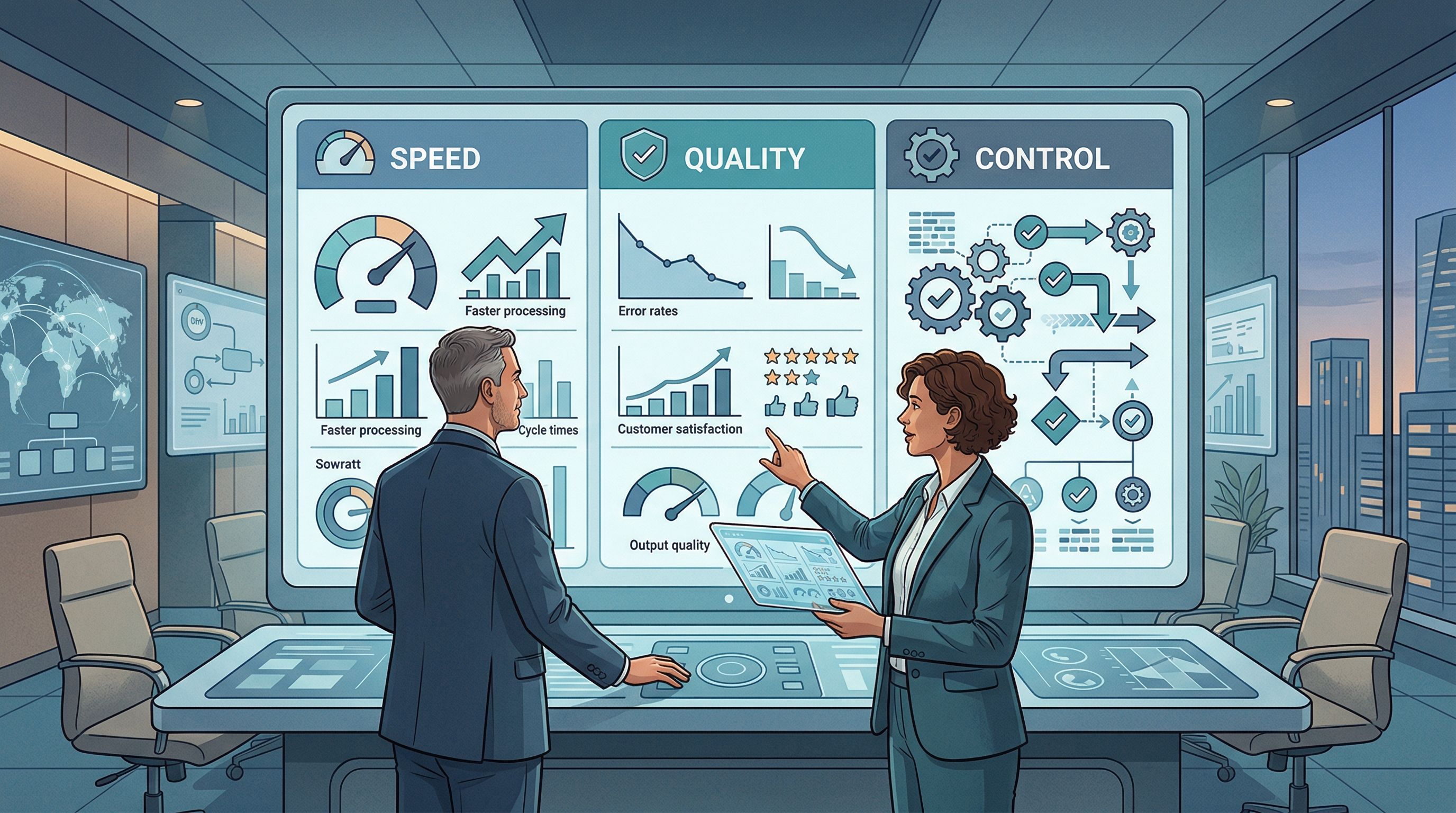
The AI conversation is becoming more disciplined. Earlier phases focused heavily on experiments, use cases, and model choice. In 2026, more leadership teams are asking a simpler question: what is the actual return? Not in theory, but in workflows, team performance, and controllable outcomes.
That is a healthy shift. McKinsey's The state of AI in 2025 suggests that many organizations now use AI broadly, but the largest gains appear in a smaller group that connects AI to process redesign and active management. The Stanford AI Index shows that investment, model performance, and usage have all matured. As adoption grows, it becomes harder to stay vague about value. The more serious AI becomes, the more serious measurement must become too.
Why AI ROI often feels difficult
Traditional ROI models assume a relatively direct line between investment and return. AI is rarely that simple. The value is not only in hours saved. It also appears in shorter turnaround times, better consistency, fewer errors, faster onboarding, lower dependence on scarce experts, and stronger decision quality.
At the same time, there are real costs and risks that cannot be ignored: model usage, integration, governance, training, monitoring, and change effort. That is why AI ROI often breaks down in one of two ways. Either organizations barely measure anything and keep talking about "potential." Or they reduce everything to time saved and miss the broader operational effect.
Measure AI across five dimensions
A workable approach tracks at least five dimensions at the same time.
1. Speed. How much faster is a task, case, request, or decision prepared and completed?
2. Quality. Does the system reduce errors, improve consistency, or raise first-time-right performance?
3. Capacity. Can the team handle more work without proportional growth in staffing?
4. Adoption. Are employees using the solution in a real, safe, and repeatable way?
5. Control. Does the deployment remain explainable, reviewable, and manageable within governance and privacy boundaries?
Together, these dimensions create a far more realistic picture than a single financial number. In knowledge-heavy and public-facing environments, that broader view is essential.
Start with process value, not model value
A common mistake is evaluating AI based on how impressive the model is instead of how much the process improves. A strong demo means very little if turnaround time does not change, employees do not trust it, or outputs still need to be rebuilt manually.
So the first question should not be, "How good is the model?" It should be, "Which step in this workflow do we want to improve?" Is the goal faster responses, less search effort, better triage, more consistent advice, less rework, or stronger decision preparation?
Once that process question is clear, measurement becomes meaningful. AI is no longer judged like a technical novelty, but like an operational intervention.
A practical ROI scoreboard
For many organizations, a compact scoreboard works better than a heavy business-case model. For each use case, you can track a baseline and monthly view across metrics such as:
- average turnaround time;
- error rate or rework;
- number of cases or tasks handled per employee;
- usage frequency and active adoption;
- number of escalations or exceptions;
- degree of required human review;
- employee or end-user satisfaction.
This prevents value from staying invisible until finance builds a perfect model. Instead, the organization develops a credible evidence base over time.
Where value usually becomes visible first
In practice, AI ROI tends to appear fastest in three kinds of workflows.
Knowledge-intensive processes. Examples include file analysis, internal support, reporting, and policy support. AI often improves both speed and consistency here.
Repeatable decision preparation. Intake, triage, quality control, and scenario comparison all benefit because people can focus more quickly on exceptions and judgment.
Expertise bottlenecks. When critical knowledge sits with a small number of specialists, AI can make that expertise more accessible. That reduces waiting time and dependence.
The striking pattern is that value rarely starts with the most dramatic use case. It usually starts where information density, repetition, and decision points come together.
From pilot ROI to portfolio ROI
Once multiple AI applications go live, the governance question changes as well. You no longer want to know only whether one use case pays off. You want to know whether the overall AI portfolio is healthy. Which deployments are gaining usage? Which create structural value? Which generate too many exceptions? Where are licensing and maintenance costs accumulating without clear benefit?
That requires portfolio steering. Not every experiment needs to pay off immediately, but a mature AI program should be able to show where value is being created, where something should stop, and where scaling makes sense.
2026 requires mature measurement discipline
The organizations that get the most from AI in 2026 will not necessarily be the ones with the largest number of pilots. They will be the ones that treat AI as a managed capability with explicit metrics, ownership, and review moments.
AI ROI is therefore not only about money. It is about visible improvement in speed, quality, capacity, and control. Organizations that measure those clearly can decide much faster where AI truly belongs.
Want AI to contribute measurably to speed, quality, and process outcomes instead of staying experimental? PrudAI helps organizations select use cases, define metrics, and scale implementation responsibly. Reach out through contact or explore AI Services.
Sources
- McKinsey, The state of AI in 2025
- McKinsey, The State of Organizations 2026
- Stanford HAI, AI Index Report 2025