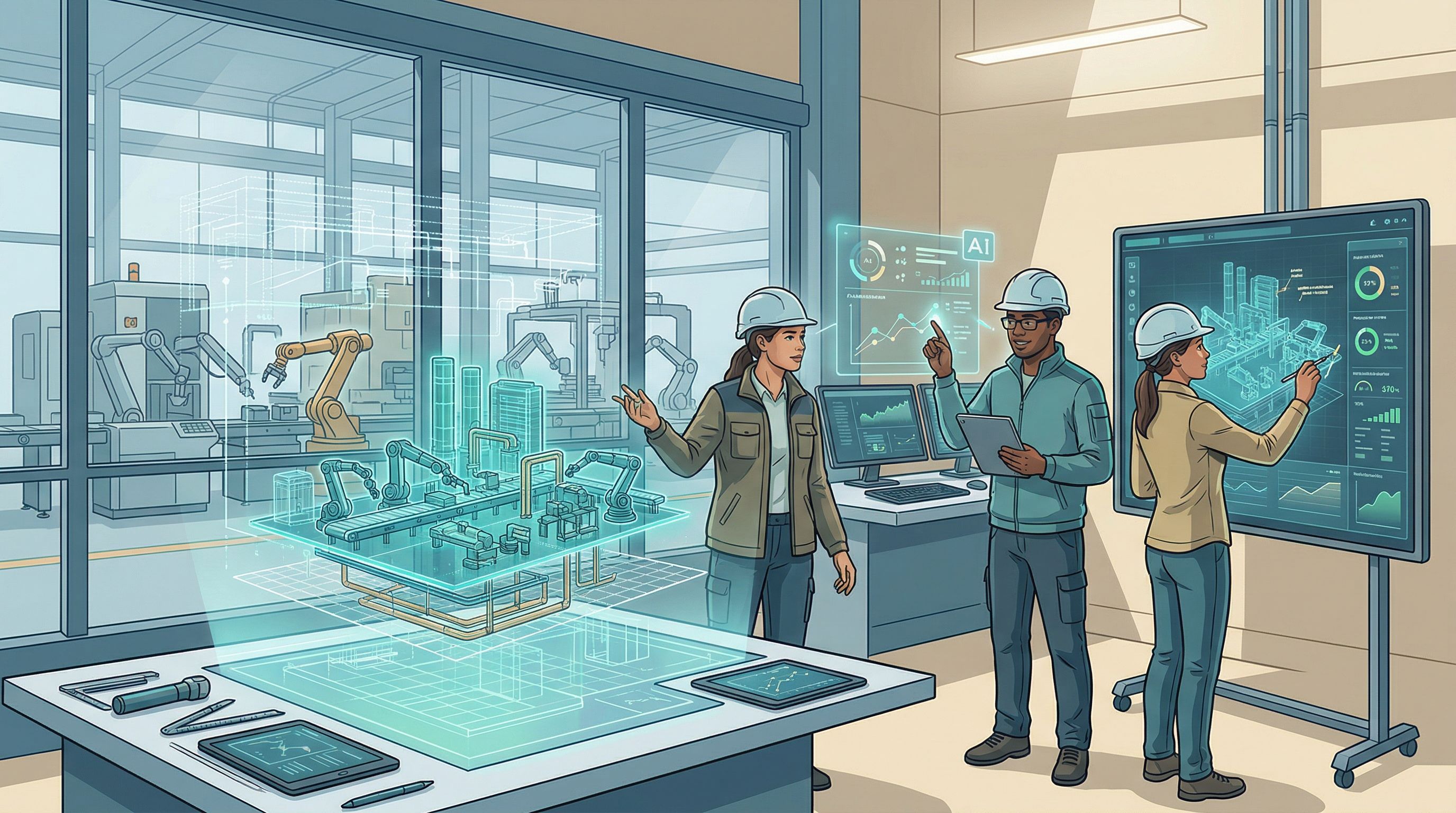
In many industrial organizations, AI is no longer just an analytics capability used by a specialist team. It is moving closer to day-to-day operations: planners, engineers, maintenance teams, estimators, and quality leads increasingly rely on AI to understand what is happening and what the next best step should be.
The European Commission explicitly highlighted that shift in late 2025 through flagship actions under its Apply AI strategy for manufacturing, engineering, and construction. The announcement described manufacturing as a key pillar of the European economy, with 2.2 million enterprises, around 30 million jobs, and roughly a quarter of EU business-economy revenue. In that same context, AI-powered digital twins were identified as a central technology for simulating and optimizing production systems, supply chains, and infrastructure before choices are implemented in the real world.
Why these sectors benefit right now
Manufacturers, engineering firms, and construction organizations face the same pressures: scarce expertise, high failure costs, large document sets, complex dependencies, and very little room for delay. AI is especially powerful here because it can do more than produce isolated analysis. It can connect context across drawings, maintenance history, project schedules, quality reports, manuals, and live signals.
That changes the nature of decision support. Instead of a dashboard that still expects someone to manually connect all the dots, organizations can create workflows in which AI flags anomalies, summarizes relevant documentation, compares scenarios, and helps people reach better decisions faster.
The role of the digital twin
A digital twin creates real value when it is not just a visual mirror of an asset or process, but a decision layer. Think of a production environment where scheduling data, sensor streams, maintenance history, and quality measurements come together. Or a construction project where design changes, material planning, risk, and progress constantly affect one another.
AI adds value by finding patterns quickly and translating them into something operational teams can act on. Examples include:
- forecasting which disruption will have the largest impact on planning;
- proposing alternative maintenance windows;
- linking quality deviations to previous process conditions;
- summarizing technical documentation for operators or field teams;
- translating engineering changes into likely impact on supply chain, capacity, or lead time.
Four high-value application areas
1. Maintenance and downtime reduction. By combining incident history, manuals, and live signals, AI helps technicians move faster toward a reliable fix. This is exactly the type of setting where an AI knowledge base or agentic support workflow creates direct value.
2. Production and project planning. AI can compare scenarios as materials, capacity, or priorities shift. That improves not just speed, but the quality of the trade-off.
3. Quality control. In production environments, AI can detect anomalies, cluster likely causes, and surface similar historical patterns. In engineering and construction, it can assist with document checks, revisions, and evidence tracking.
4. Shop-floor and field knowledge access. Critical know-how is often buried in documents, instructions, emails, and the heads of experienced employees. AI makes that knowledge usable much faster for less experienced colleagues.
Where implementation often breaks down
The biggest trap is assuming that digital twins or AI create value on their own. In reality, value appears only when the output connects directly to operational decision-making. If a planner still has to open three systems to understand one deviation, very little is gained. If a technician receives advice without traceable grounding, trust disappears.
That is why process design matters. Define who receives which signal, which source is authoritative, when a human makes the decision, and how feedback returns to the system. Without that structure, you may get interesting insights, but not faster decisions.
How to start sensibly
Choose a limited but business-critical workflow: failure analysis, quality deviations, engineering changes, or project planning decisions. Gather the relevant data and document sources. Then define which decision you want to accelerate and what role AI should play in it. Only after that should you build the chain of retrieval, analysis, validation, and reporting.
Organizations that do this well usually see two effects at once: faster operational response and less dependency on scarce experts for routine analysis. That is what makes AI especially attractive in these sectors. It improves efficiency, but also resilience and adaptability.
Want to explore where AI, digital twins, and knowledge access can generate the most value in your industrial or project environment? PrudAI can help. Reach out through contact or explore AI Services.
Sources
- European Commission / Apply AI Alliance, AI for Manufacturing, Engineering and Construction
- EuroHPC JU, AI Factories in Europe
- Stanford HAI, AI Index Report 2025