
In brief
- The requirements for high-risk AI under Annex III of the AI Act apply from 2 December 2027. The original date was 2 August 2026; Regulation (EU) 2026/1744 moved it.
- For high-risk AI in products under Annex I (such as medical devices, toys and lifts) the date is 2 August 2028.
- Most obligations sit with the provider: risk management, technical documentation, logging, human oversight by design and a conformity assessment.
- An organisation that uses such a system (the deployer) has its own obligations under Article 26, such as human oversight, keeping logs and informing workers. Public bodies also carry out a fundamental rights impact assessment (Article 27).
- The Act does not know a general "AI Act audit". There is a conformity assessment before the market and market surveillance afterwards.
When do the rules for high-risk AI apply?
The AI Act (Regulation (EU) 2024/1689) applies in stages. On 24 July 2026 the Digital Omnibus on AI, Regulation (EU) 2026/1744, was published in the Official Journal. It moved the date for high-risk systems. The legislator points to the delayed availability of standards and the late set-up of national authorities.
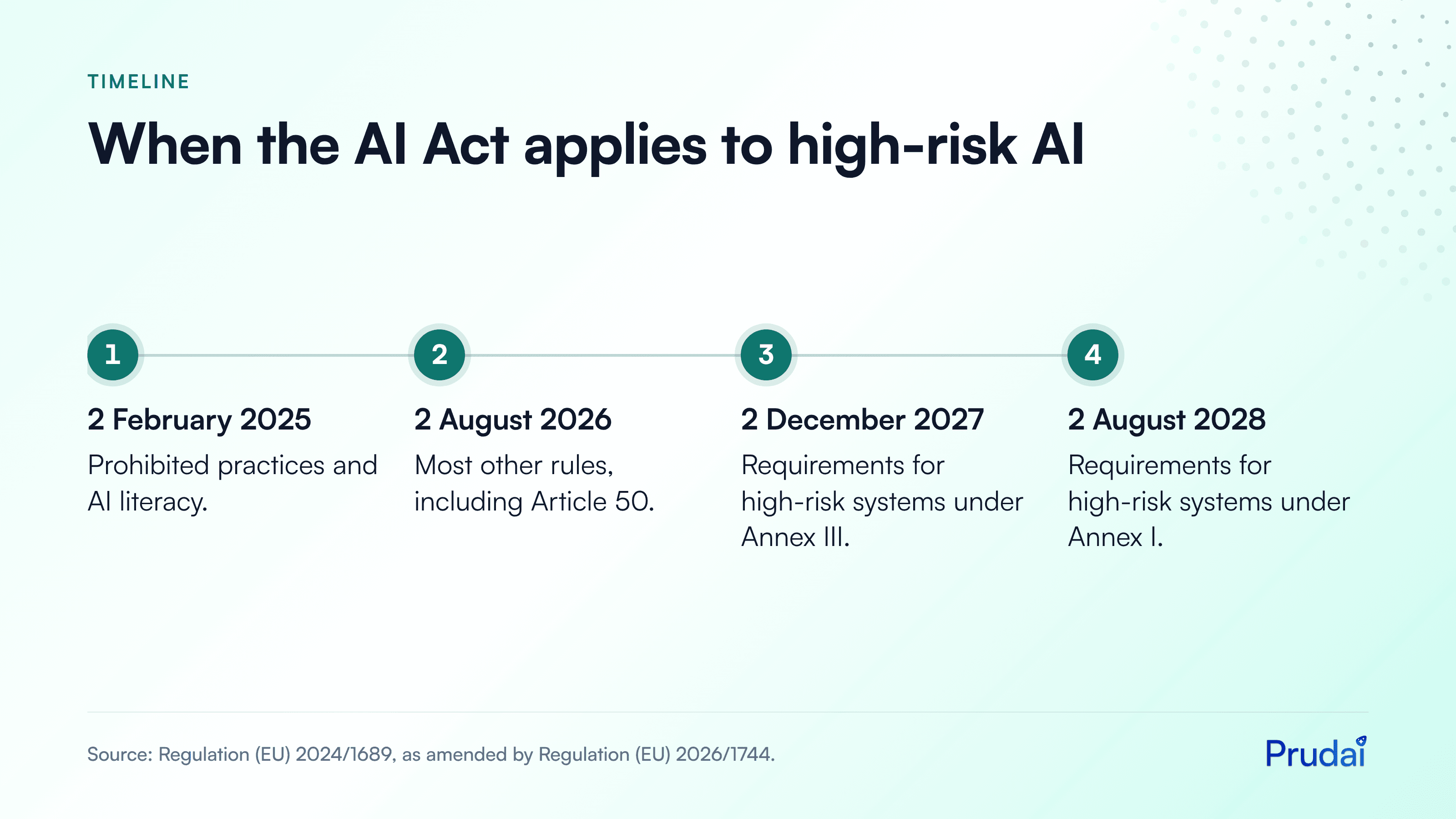
AI Act timeline: since 2 February 2025 prohibited practices and AI literacy, since 2 August 2026 most other rules, from 2 December 2027 high-risk AI under Annex III and from 2 August 2028 under Annex I.
| Date | What applies |
|---|---|
| 2 February 2025 | Prohibited AI practices (Article 5) and AI literacy (Article 4) |
| 2 August 2025 | Rules for general-purpose AI models, governance and penalties |
| 2 August 2026 | Most other rules, including the transparency obligations of Article 50 |
| 2 December 2027 | Requirements and obligations for high-risk systems under Annex III |
| 2 August 2028 | Requirements and obligations for high-risk systems under Annex I |
That gives time, but preparation takes that time too. A provider needs its documentation, risk management and quality system in order by then. A deployer needs to know which systems it uses and who oversees them.
What is a high-risk system under Annex III?
Annex III lists eight areas. An AI system intended for one of the listed uses within those areas counts as high-risk:
- Biometrics, such as remote biometric identification and emotion recognition.
- Critical infrastructure, as a safety component for road traffic, water, gas or electricity, for example.
- Education and vocational training, such as admission and evaluating learning outcomes.
- Employment and workers management, such as recruitment, selection and assessing employees.
- Access to essential services and benefits, such as assessing eligibility for benefits or creditworthiness.
- Law enforcement.
- Migration, asylum and border control.
- Administration of justice and democratic processes, such as assisting a judge in researching and interpreting facts and the law.
Not every system in those areas is automatically high-risk. If it only performs a narrow procedural task, or a preparatory task, and does not materially influence the outcome, it can fall outside (Article 6(3)). An Annex III system that profiles natural persons is always high-risk. The provider must document its assessment.
Are you a provider or a deployer?
That distinction determines your obligations. The provider develops the system and places it on the market, usually your supplier. The deployer uses it under its own authority, usually your organisation.
| Obligation | Provider | Deployer |
|---|---|---|
| Risk management system throughout the lifecycle | Yes (Article 9) | No |
| Quality of training and test data | Yes (Article 10) | Only for input data under its control (Article 26(4)) |
| Technical documentation and instructions for use | Yes (Articles 11 and 13) | Uses the system according to the instructions (Article 26(1)) |
| Automatic logging | Build it in (Article 12) | Keep logs for at least six months, where under its control (Article 26(6)) |
| Human oversight | Enable it by design (Article 14) | Assign it to competent people with authority (Article 26(2)) |
| Conformity assessment, CE marking, registration | Yes (Articles 16, 43, 48 and 49) | No. Public authorities do register their use in the EU database (Article 26(8) and Article 49) |
| Informing workers | No | Yes, before use in the workplace (Article 26(7)) |
| Fundamental rights impact assessment | No | Public bodies and private entities providing public services, and for credit and insurance assessments (Article 27) |
Note: anyone who places a high-risk system on the market under its own name, or substantially modifies it, can become a provider (Article 25).
Is there such a thing as an "AI Act audit"?
Not as a general obligation. The AI Act works with two instruments:
- Conformity assessment beforehand. The provider shows that the system meets the requirements before it is placed on the market. For most Annex III systems (points 2 to 8) this is done through internal control, without a notified body (Article 43(2)).
- Market surveillance afterwards. Authorities can check systems on the market and request information (Article 74).
As a deployer you will not get a periodic audit, but you must be able to show that you meet your obligations under Article 26. Breaches of the obligations of providers or deployers can lead to fines of up to 15 million euros or 3% of worldwide annual turnover, whichever is higher (Article 99(4)). For SMEs and small mid-caps the lower amount applies (Article 99(6) and (6a)).
How do you prepare?
- Take stock. Make an overview of the AI systems in your organisation, including those built into supplier software.
- Classify. Do systems fall under Annex III? Record your reasoning, also when the answer is no.
- Determine your role. Are you a provider, a deployer, or both?
- Ask your supplier. Ask about the conformity assessment, the instructions for use and how human oversight and logging are set up.
- Assign oversight. Name, per system, who oversees it, with the knowledge and authority to intervene.
- Arrange logs and reporting. Keep the logs and agree how you report serious incidents to the provider and the authority.
- Carry out a fundamental rights impact assessment if you have a public task. For Dutch municipalities the IAMA is a useful starting point; see the IAMA for municipalities.
For the public sector, transparency towards citizens matters as well. More in AI in the public sector.
How it works at Prudai
Prudai builds IRMA, governance, risk and compliance software. IRMA includes an algorithm register, a risk register with controls, DPIAs and a register of suppliers and contracts. It contains the ISO/IEC 42001 framework (the management system for AI), with a Statement of Applicability under version control.
In IRMA's process editor you draw a process, and IRMA can suggest a risk or control for each step. Every suggestion comes with a rationale and a source reference, and only becomes a link once a staff member approves it. The registers also work entirely without AI.
A framework in the software does not make you compliant. It does help you keep the inventory, the classification and the evidence in one place.
For the specialist
- Existing systems. A high-risk system placed on the market before the date of application only falls under the rules if its design is significantly changed afterwards. Systems intended for use by public authorities must comply by 2 August 2030 at the latest (Article 111(2), as amended by Regulation (EU) 2026/1744).
- Article 50 for existing systems. For generative systems placed on the market before 2 August 2026, the marking obligation of Article 50(2) only applies from 2 December 2026 (Article 111(4)).
- Which parts move. The new date applies to Chapter III, Sections 1 to 3 (classification, requirements and obligations of providers and deployers). See Article 113, third paragraph, point (c), as amended.
- FRIA and DPIA. If you already carried out a DPIA under Article 35 GDPR, the fundamental rights impact assessment may refer to it or include parts of it (Article 27(4), as amended).
- The Article 6(3) exception. Four situations: a narrow procedural task, improving the result of previously completed human work, detecting deviations from decision-making patterns without replacing the human assessment, and a preparatory task. Profiling never qualifies.
- AI literacy. Since the July 2026 amendment, Article 4 requires providers and deployers to take measures to support the AI literacy of their people. See AI literacy under the EU AI Act.
Frequently asked questions
When do the requirements for high-risk AI apply?
For Annex III systems from 2 December 2027, and for Annex I systems from 2 August 2028. These dates come from Regulation (EU) 2026/1744, which amended the AI Act on 27 July 2026.
Is my AI system high-risk?
Check whether it is intended for a use listed in Annex III, such as recruitment, access to benefits or education. If so, it is high-risk, unless it only performs a narrow or preparatory task and does not materially influence the outcome. An Annex III system that profiles natural persons is always high-risk.
Do I need a conformity assessment as a deployer?
No, the provider does that. As a deployer you do have your own obligations, such as human oversight, keeping logs and informing workers (Article 26).
Is a chatbot or language model high-risk?
Usually not. It depends on the use, not on the technology. A chatbot that answers questions is not a high-risk system, but a system that selects job applicants is. Chatbots are subject to the transparency obligation of Article 50.
Who supervises the AI Act in the Netherlands?
The AI Act requires member states to designate market surveillance authorities. Follow the Dutch government and the regulators for the current state of play.
Sources
- Regulation (EU) 2024/1689 (AI Act), Official Journal 12 July 2024
- Regulation (EU) 2026/1744 (Digital Omnibus on AI), Official Journal 24 July 2026
- European Commission, AI Act Service Desk: timeline (consulted 6 October 2026)
- Algorithm register of the Dutch government
What generative AI is and which other AI Act rules apply is explained in What is generative AI?.
Would you like to know how to take stock of and classify your AI systems in one register? See IRMA.
Updated on 6 October 2026