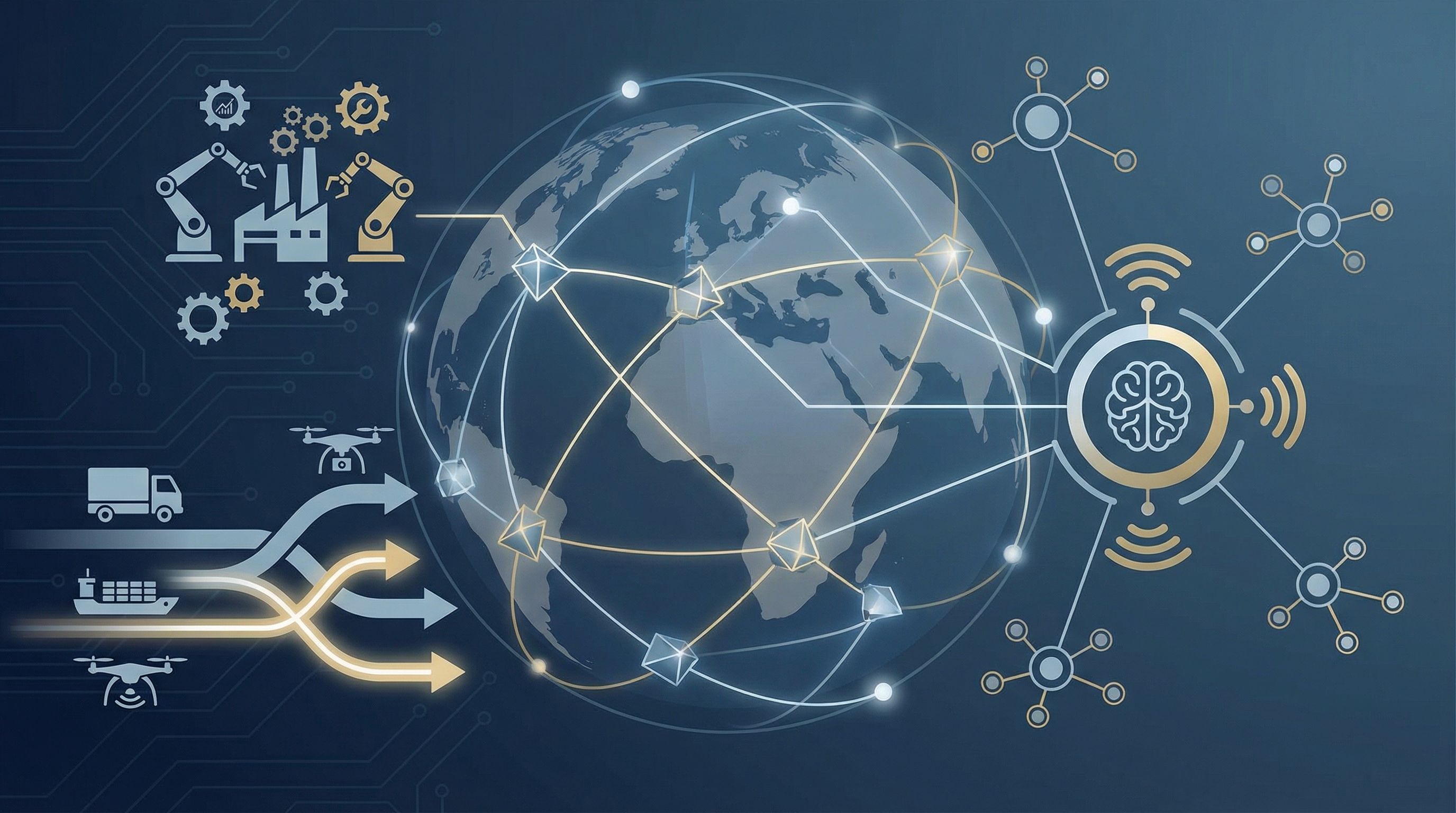
The global logistics disruptions of March 2026 presented an unprecedented challenge. Geopolitical tensions across key sea routes, combined with overlapping holidays, exposed a painful truth: static planning and reactive dashboards are no longer sufficient. By the time a human planner analyzed a flashing red alert on a dashboard and approved an alternative, the delay was often already irreversible. This proved to be the breaking point for traditional, rules-based logistics software.
Today, we are witnessing a fundamental shift toward the Agentic Supply Chain. Where earlier AI systems merely predicted and warned, autonomous agents now take direct action. They execute complex logistics playbooks—such as real-time rerouting and dynamic inventory allocation—entirely without manual data entry from human operators.
From Analysis to Autonomous Execution
For years, the manufacturing sector struggled with the gap between insight and action. Organizations knew that a delivery was delayed, but it took hours or even days to rebook freight, adjust production schedules, and source viable alternatives.
Agentic AI closes this gap through Automated Disruption Management. Using multi-agent orchestration, specialized systems now collaborate in lightning-fast workflows:
- Real-time rerouting: When a disruption occurs, a logistics agent uses external data signals and Deep Reinforcement Learning to calculate an alternative route and lock in the new booking within 90 seconds.
- Dynamic inventory balancing: Simultaneously, another agent analyzes the impact on production schedules and independently triggers orders to balance safety stock between warehouses.
The Human Role in the AI-Enabled Supply Chain
This shift does not mean humans disappear; rather, the human role becomes highly strategic. As we noted in our analysis of the AI-enabled organization in 2026, supply chain professionals transition from reactive executors to proactive directors. They set the operational boundaries—such as the maximum acceptable additional costs for air freight or minimum delivery reliability requirements—and the agents operate strictly within those parameters.
Furthermore, we see the power of interconnected systems across departments. When a transport agent detects an unsolvable delay, it instantly communicates with autonomous procurement agents to rapidly source local suppliers and execute temporary contracts. This is the true promise of agentic workflow automation: cross-departmental bottlenecks are resolved in seconds rather than days.
Measurable Impact for Manufacturing
In the manufacturing sector, everything revolves around uptime and protecting margins. Deploying agentic AI for disruption mitigation not only minimizes production downtime but also directly reduces operational costs like demurrage, storage, and expensive emergency transport. This perfectly aligns with our vision for AI ROI in 2026, where artificial intelligence investments are no longer about experimentation, but about generating immediately measurable business value within core processes.
Sources
- Supply Chain Dive: Autonomous Agents in Disruption Management
- Accenture: Supply Chain Agentic Transformation
- World Bank: Digital Trade and AI Resilience
Would you like to know how PrudAI can help you transition to Autonomous Supply Chain Management? Contact our experts to discover how we can securely integrate autonomous agents into your logistics operations with measurable impact.